










Van campers shopping for cold storage face a genuinely forked road, and the fork is sharper than most gear roundups let on. The 12V cooler vs ice cooler question sounds like a simple budget call, but it turns on three variables that rarely get named together: your van's electrical capacity, how many miles of driving separate your campsites, and whether your trip crosses the 48-hour mark.
If you're running a stock alternator with no auxiliary battery, a compressor fridge will drain your starter battery overnight. That's not a worst-case scenario; it's the predictable outcome of ignoring amp-hour math. On the other hand, if you're filling a quality ice chest every day-and-a-half from a gas station, you're paying roughly $15 - $25 per fill in bagged ice while also sacrificing a third of your storage space to the ice itself.
The honest tension here: the option that costs less upfront often costs more per trip once you run the real numbers over a weekend. That gap doesn't close the way most people expect it to, and it depends entirely on one factor most guides leave as a footnote.
What Each Option Actually Demands From Your Van
Start with what you're already working with, because both cooler types make hidden demands on your setup.
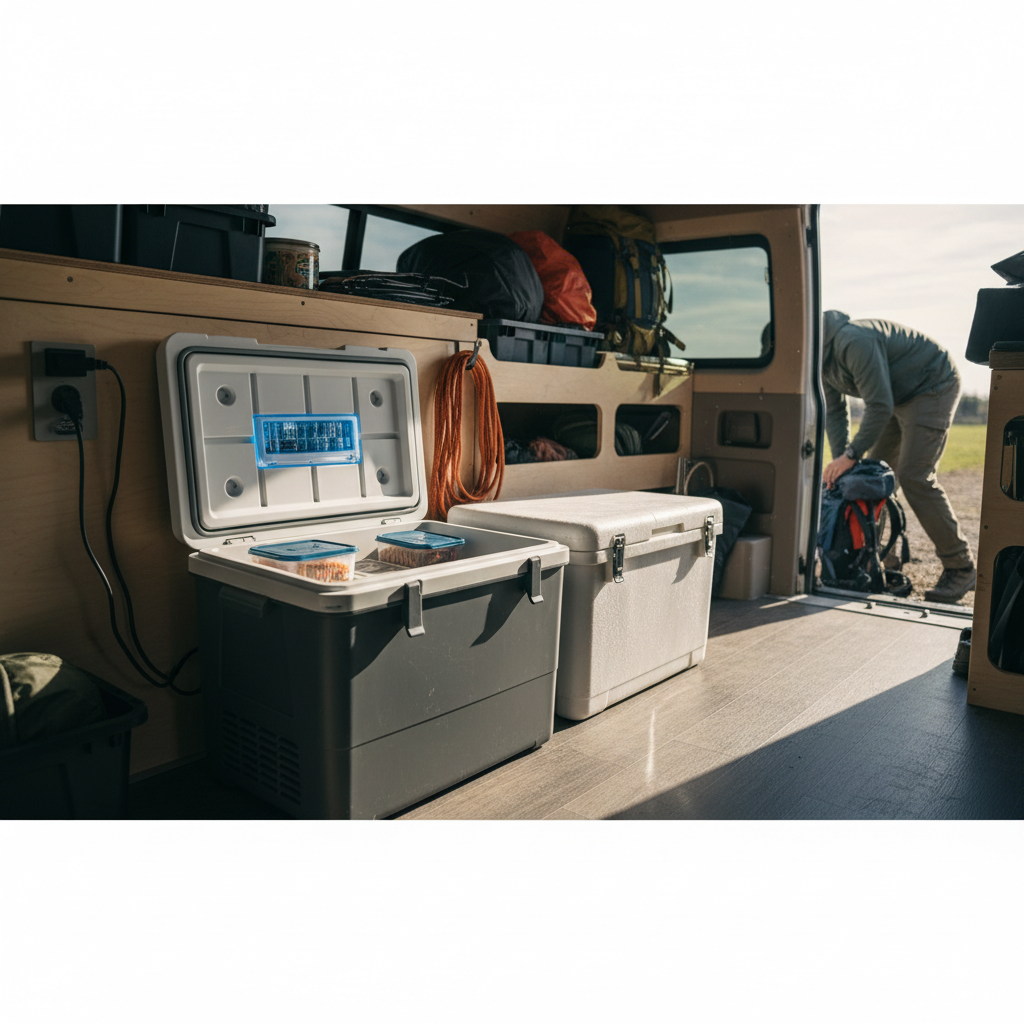
A 12V compressor cooler (the real kind, not a thermoelectric "cooler" that only drops temperature 40°F below ambient) typically draws between 3 and 5 amps while the compressor runs, cycling on and off to maintain temperature. At a moderate duty cycle, that's roughly 30 - 45 amp-hours per 24 hours. A standard Group 24 auxiliary AGM battery holds around 75 usable amp-hours before you risk damaging it. Or rather: it holds 75 amp-hours total, but discharging an AGM below 50% shortens its lifespan significantly, so your real working budget is closer to 37 amp-hours. A weekend without meaningful solar input or a long driving stretch each day puts you right at that edge.
An ice cooler demands nothing from your electrical system. What it demands is ice. A quality rotomolded chest from a brand like YETI or Pelican will hold ice for 3 - 5 days in moderate conditions (under 80°F ambient, out of direct sun). A cheaper polyfoam chest might last 18 - 24 hours in the same conditions. That range isn't incidental; it's the decision-relevant variable most ice cooler comparisons bury in fine print.
So the real comparison isn't "electric vs ice." It's your specific power budget against your specific ice access and storage tolerance. Neither option wins in a vacuum.
The Cost Math for a Typical US Weekend Trip
Run the numbers for a standard Friday-to-Sunday van trip before committing to either side.
Ice side first. A 20-pound bag of cubed ice at a gas station or grocery store runs $4 - $6 in most US markets. A quality 65-quart rotomolded chest ($250 - $400) will need one re-ice on a 3-day trip in summer, possibly two if temperatures spike above 90°F. Call it $10 - $12 in ice per weekend, plus the chest's amortized cost over its lifespan. That's manageable. The hidden cost is the 15 - 20 quarts of storage you lose to ice volume. In a 65-quart chest, that's nearly a third of your usable space permanently occupied by frozen water.
Electric side. A decent 12V compressor cooler runs $200 - $600 (BougeRV, Iceco, and Dometic are the brands most van-lifers actually use). If you don't already have an auxiliary battery and some solar, add $300 - $800 for a basic 100Ah lithium iron phosphate battery and a 100-watt panel. That's a real upfront number. But once the system exists, your per-trip cold storage cost drops to nearly zero. No ice runs, no lost storage, and you can set the temperature to exactly 37°F rather than hoping your food sits above the meltwater.
That puts it around this: if you take six or more weekend van trips per year and you're buying ice both days, the 12V system pays for itself in avoided ice costs and recovered storage space within two to three years. Fewer trips, and the ice chest wins on pure economics. The math shifts further toward electric if you're already planning a solar setup for other reasons (phone charging, lighting, a fan).
Where Each Option Breaks Down
The 12V cooler has a real failure mode that gets glossed over: it needs the van to be running, or it needs stored power. Park for two days at a primitive campsite with no solar and a modest auxiliary battery, and you'll wake up Sunday morning to a warm cooler. A common guideline among overlanders is that a 100Ah lithium battery paired with a 100-watt solar panel is the minimum viable setup for a 12V compressor fridge in the US Southwest, where sun is reliable. In the Pacific Northwest in October, that calculus changes. Cloud cover reduces solar input dramatically, and your driving time may not compensate.
The most common mistake I see is people buying a 12V cooler as their first van purchase, before they've sorted out their electrical system. The cooler is fine. The under-equipped electrical setup kills the experience.
Ice coolers break down differently. They don't fail suddenly; they degrade gradually as the ice melts and your food approaches the 40°F food safety threshold. The FDA identifies 40°F as the upper boundary for safe cold food storage, and once your ice chest crosses that line, you're in a different conversation entirely. Cheap chests reach that point in under 24 hours on a hot day. If you ignore the cooler quality variable and buy a $30 foam chest for a 3-day desert trip, you're not just uncomfortable. You're gambling with food safety.
This article is not covering thermoelectric coolers (the 12V units that use a Peltier element rather than a compressor). They're cheaper, but they can't reliably cool below ambient temperature in hot conditions, which makes them poorly suited for weekend van trips where food safety actually matters. Skip them.
How to Decide Based on Your Actual Setup
Three questions settle this faster than any gear review.
First: do you already have an auxiliary battery? If yes, and it's 100Ah or larger, a 12V compressor cooler is probably your better long-term move. If no, add the cost of the electrical system to the cooler's price tag before comparing.
Second: how often do you pass gas stations or grocery stores during your trips? If you're on an established route with town stops every day, ice resupply is simple. If you're deep in BLM land for three days with no resupply, the ice chest math gets brutal fast (and the 12V case strengthens, provided your power setup can handle it).
Third: how much of your cooler space is actually food? Check cooler size, device count, and your real daily power budget first. A 12V unit makes more sense if you cook real meals requiring temperature-sensitive proteins. An ice chest is perfectly fine if your weekend food is mostly beer, sandwich stuff, and snacks that tolerate some temperature swing.
I'd start with the ice chest if this is your first van trip and your electrical system is stock. Get a rotomolded chest from a brand with documented ice retention specs (YETI publishes independent test data; so does Pelican), load it correctly (pre-chill it 24 hours before packing, layer ice below and above food, minimize lid openings), and see how your actual usage patterns feel. Then decide whether a 12V upgrade makes sense after you've run a few weekends.
If you do nothing else, do these: pre-chill the chest, keep it out of direct sun, and don't use it as a seat (repeated pressure degrades the gasket seal on cheaper chests). Those three habits extend ice life more than the brand name on the outside.
The One Variable That Changes Everything
Trip duration is the single factor that most decisively separates the two options, and it's the one most comparison guides treat as background noise.
Under 48 hours, a quality ice chest wins almost every time. Lower upfront cost, zero electrical complexity, and a rotomolded chest will still have ice to spare when you're packing up Sunday afternoon. The 12V cooler's advantages (zero ongoing cost, precise temperature control, no ice loss) don't have enough time to materialize.
Beyond 72 hours, the equation flips. Ice resupply becomes a logistical chore rather than a minor errand, and the food safety math gets tighter. A compressor fridge running on a solid electrical setup holds 37°F indefinitely, regardless of trip length. That framing misses something, though: "indefinitely" only holds if your power system is genuinely adequate. An underpowered electrical setup on a long trip is worse than a good ice chest, not just equivalent.
The weekend van trip sits right at the inflection point. That's what makes this decision genuinely interesting and what makes generic "just buy the 12V, it's better" advice so unhelpful for a first-timer without an existing electrical system.