









Sleep specialists who outfit van conversions will tell you to nail down your ventilation setup before you pick a mattress topper, and there's a reason for that. A topper that performs beautifully in a well-ventilated van becomes a sweaty, compressed nightmare in one that runs warm and humid.
Memory foam and latex toppers for van mattresses both promise comfort, but they fail in opposite ways and under opposite conditions. Memory foam traps heat and softens under body weight in ways that work against van sleepers who share a small platform bed. Latex breathes better and holds its shape, but it's heavier, more expensive, and responds differently depending on whether you run hot or cold.
The variables that actually matter here are your van's ambient overnight temperature, your body weight, how much you move during sleep, and whether you're sleeping solo or with a partner. None of those are resolved by reading a generic topper review. And the uncomfortable truth is that the most common van life recommendation, a 2-inch memory foam topper from a big-box retailer, is actively wrong for a meaningful slice of van dwellers.
How Each Material Actually Behaves in a Van
Memory foam is viscoelastic. It softens in response to heat and pressure, which means it conforms closely to your body shape. That conforming quality is what makes memory foam feel luxurious in a climate-controlled bedroom. In a van, it introduces two problems that bedroom reviews don't mention: heat retention and moisture absorption.
Van sleeping platforms typically sit close to the floor or against a wall with limited airflow underneath. Memory foam's cell structure resists air movement, so the heat your body generates accumulates in the foam rather than dissipating. On a warm night, a 2-inch memory foam topper can add several degrees of perceived sleeping temperature. Worse, in high-humidity environments (coastal areas, rainy seasons, or a van with limited ventilation), memory foam absorbs moisture and can begin to harbor mold within a few months. That's not a theoretical concern. It's the single most common reason van dwellers replace their sleep setup inside the first year.
Latex behaves differently at the cellular level. Natural latex, whether Dunlop-process or Talalay-process, uses an open-cell structure with pinhole perforations that allow air to move through the material. That airflow keeps sleeping temperature lower and dramatically reduces moisture accumulation. A latex topper also doesn't take on a body impression the way memory foam does. It pushes back with consistent support rather than conforming to your shape, which is either a feature or a bug depending on your preference.
Or rather: the open-cell distinction matters more than the brand name or the price tag. Cheap latex toppers sometimes use blended or synthetic latex with partially closed-cell structure, and they perform significantly closer to memory foam than to true natural latex. If you're buying latex specifically for breathability, look for toppers that specify Dunlop or Talalay processing and show ILD (indentation load deflection) ratings. An ILD between 20 and 30 is a practical range for most van sleepers seeking firm-but-comfortable support without sleeping hot.
The Temperature and Climate Condition That Changes Everything
Here is the decision most topper guides skip: your van's average overnight low matters more than the topper's comfort rating in a showroom.
If you sleep in a van where overnight temperatures regularly stay above 65°F (whether that's a warm-climate build, a city van that holds heat from the day, or a two-person setup that generates body heat), memory foam is a genuine liability. The material's heat retention compounds with ambient warmth, and most sleepers report waking sweaty and uncomfortable after the first few hours. Latex is the correct call here.
But if you sleep in a van that runs cold, say, a high-altitude build, a northern winter setup, or a single occupant in a well-ventilated but unheated van, memory foam's heat retention can actually work in your favor. The topper holds warmth close to your body and reduces the heating load on your van's climate system. In this specific condition, the standard recommendation reverses.
A common guideline among van conversion builders is that a two-person van without active climate control will average at least 10 to 15 degrees warmer than the outdoor ambient temperature once both occupants are sleeping. Keep in mind that's a practical heuristic, not a measured standard. But it does mean that a couple sleeping in the Southwest during summer can easily see interior sleeping temperatures above 85°F on a warm night, a condition under which memory foam toppers become genuinely uncomfortable rather than merely suboptimal.
So the decision tree branches early: identify your climate zone and whether you run hot or cold before anything else. If you're unsure, latex is the safer default for most US van life contexts, particularly from the Sun Belt through the Pacific Coast.
Weight, Platform, and the Practical Limits of Latex
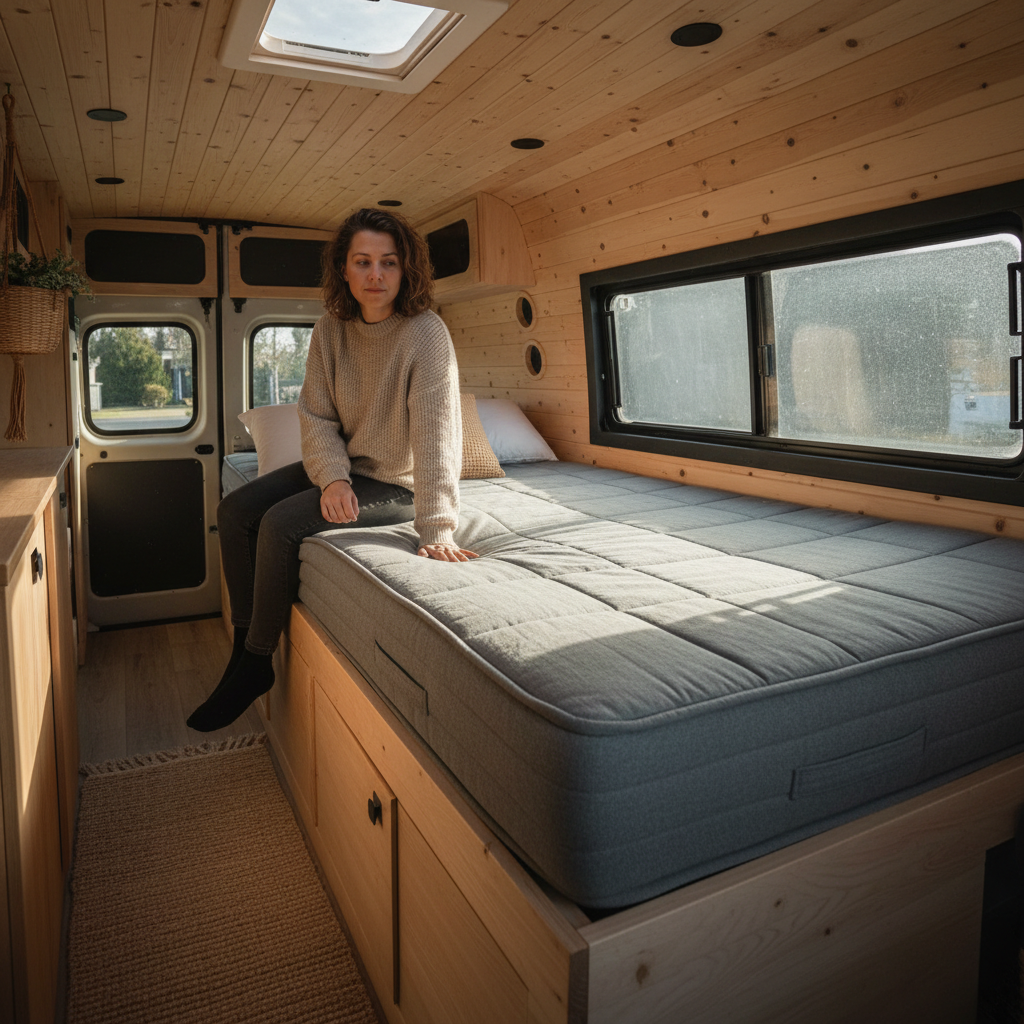
Latex has a weight problem. A 2-inch natural latex topper cut to a queen platform size (roughly 60 by 80 inches) typically weighs between 25 and 40 pounds depending on the ILD and processing method. Memory foam at the same dimensions usually runs 10 to 18 pounds. In a van where you're lifting your sleep platform to access storage underneath, that weight difference is a real ergonomic factor, especially daily.
For van dwellers who access under-bed storage every day, the lighter memory foam topper may be worth its thermal shortcomings. You can partially offset memory foam's heat retention by using a bamboo or Tencel mattress cover, which adds modest airflow at the surface, and by running a small 12V fan across the bed. It's not a perfect fix, but for storage-priority builds it's a workable compromise.
Weight also affects platform flex. Older or budget van platform builds sometimes use thinner plywood that develops a slight bow under sustained load. A heavier latex topper on a marginally built platform can accelerate that flex over time. If your platform uses less than 3/4-inch plywood across a span of more than 30 inches unsupported, check the platform's structural rating before loading a heavy latex topper.
This article isn't for people sleeping in a converted sprinter with a professional upholstery installation and a diesel heater. Those builds have different constraints. This is for the majority of van sleepers building or managing their own platform setup with standard materials and a real budget.
Which Topper Wins Under Which Conditions
Before the table below, one clarification: neither topper is universally better. The comparison only resolves when you apply your specific sleeping conditions.
| Condition | Memory Foam | Latex |
|---|---|---|
| Overnight temps above 65°F | Not recommended | Preferred |
| Cold-climate or winter build | Acceptable | Works fine; no advantage |
| High humidity or coastal use | High mold risk | Low mold risk |
| Two-person sleeping | More body heat trapped | Handles doubled heat load better |
| Daily under-bed storage access | Easier to lift | Significantly heavier |
| Budget under $120 | Widely available | Difficult to source quality |
| Back or joint pain | Softer conform; short-term relief | Consistent support over time |
| Partner with different firmness needs | Limited zoning options | Zoned latex toppers exist but are expensive |
The table makes something visible that advice articles tend to flatten: memory foam wins on cost and access, latex wins on thermal and structural performance, and the right answer genuinely depends on which row you live in.
I'd start with latex for any van build that runs warm or operates in a humid region. If your budget is tight, a medium-density latex topper in the 2-inch range from a domestic supplier costs roughly $150 to $250 for a queen, which is more than a big-box foam topper but substantially less than a full van mattress replacement when the foam fails early.
The committed specifics here: check ILD rating, confirm Dunlop or Talalay processing, and verify your platform's plywood thickness before ordering. Three things, not ten.
What Happens If You Get This Wrong
Ignore the ventilation and temperature question entirely, buy the memory foam topper because it's cheaper and easier to find, and here's what typically follows. Within three to six months in a warm or humid climate, the foam shows permanent body impressions where you sleep in the same position each night. The impressions develop into a trough shape that makes neutral sleeping positions harder to maintain. Hip and lower back discomfort follows, and most people attribute it to the platform itself rather than the topper.
The mold issue is slower but worse. Memory foam doesn't show surface mold early; it develops internally, and by the time you smell it, the topper has already been compromised for weeks. Replacing a mold-compromised topper is a straightforward cost; dealing with mold that has transferred to the platform plywood or the van's metal floor is a pain that costs both money and time.
But the real cost of getting this wrong is measured in sleep quality across months of travel, not just one bad night. Van life already degrades sleep through road noise, temperature swings, and irregular schedules. A topper that's wrong for your conditions adds a consistent sleep debt that compounds everything else.
Making the Final Call
If your van runs warm or operates in a humid region, choose a natural latex topper with an ILD between 20 and 30, Dunlop or Talalay processed, in a 2-inch thickness for most platform setups.
If your van runs cold, you access under-bed storage daily, or your budget firmly caps at $120, memory foam is workable with two conditions met: use a breathable mattress cover (bamboo or Tencel), and run a small 12V fan to improve air circulation at the sleep surface.
And if you're still uncertain? The reframe worth holding: a van mattress topper isn't a comfort upgrade the way it is in a house. In a van, it's a climate management decision first. Get the thermal and moisture question right, and comfort follows. Get it wrong, and no comfort rating on the label fixes it.