















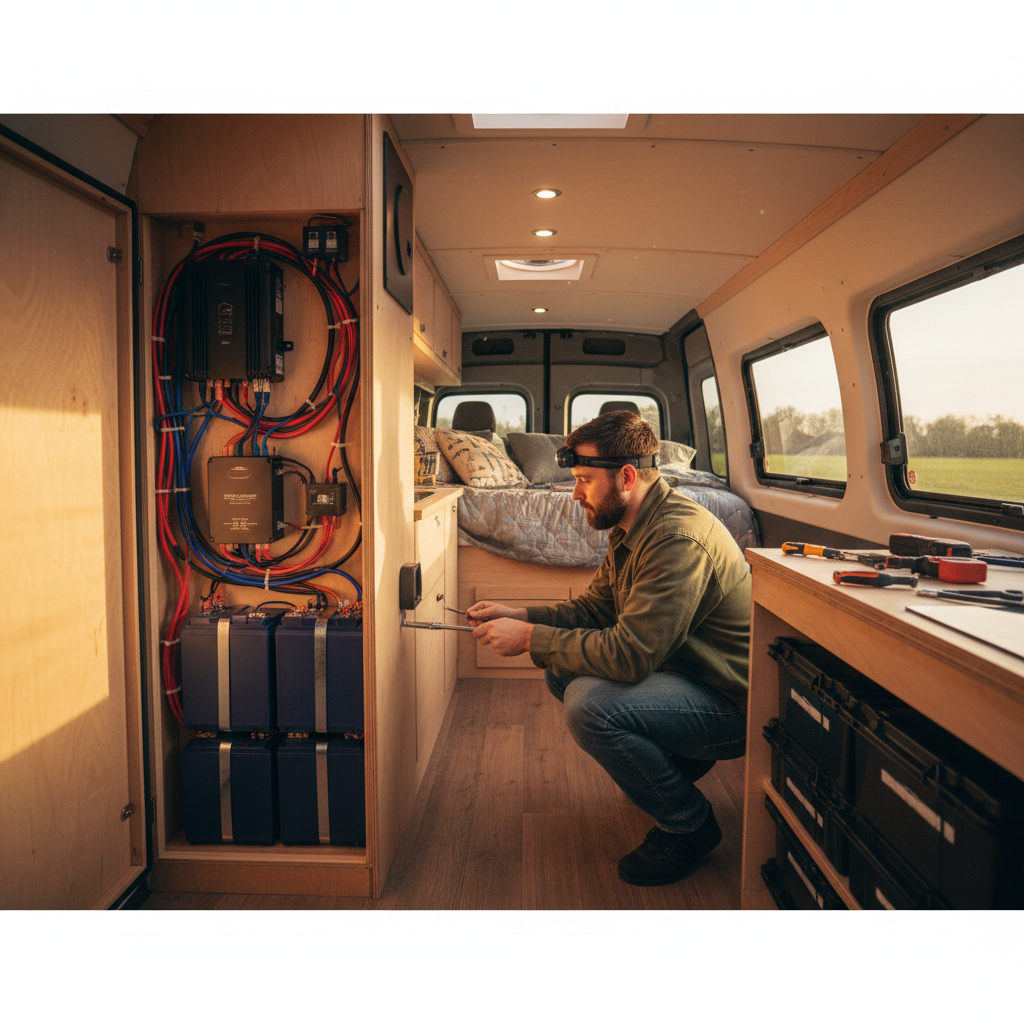
A battery installer will size your bank before they touch a single cable, and there's a reason for that. The lithium battery you pick for a camper van isn't just a purchase decision, it's a load calculation, and getting it wrong means you're either carrying dead weight or watching your lights flicker at 9 PM on a Saturday.
Lithium iron phosphate (LiFePO4) has become the default chemistry for van builds in the US over the past several years, and the reasons go deeper than marketing. The chemistry tolerates partial state-of-charge cycling far better than AGM or standard lithium ion, which matters enormously when your solar input is intermittent and your charging schedule is irregular.
Here's the tension most buyers miss: a 100Ah battery that looks sufficient on paper can fail you completely if your inverter pulls surge current above the battery's continuous discharge rating, regardless of total capacity. That gap between marketing specs and operational reality is where weekend van trips go sideways.
What You Actually Need Before You Pick a Battery
The differentiator between a van build that works and one that frustrates you isn't brand loyalty. It's whether your battery bank is sized against your real daily load, not a wishful estimate. I'd start with a load audit before looking at a single product page.
Add up the watt-hours your devices consume per day. A 12V compressor fridge draws roughly 30 to 50 watt-hours per hour depending on ambient temperature. A 1,000W inverter running a laptop and phone chargers for four hours pulls 400 Wh. A diesel heater's control board adds maybe 10 Wh overnight. That's a conservative daily load around 550 to 650 Wh for a minimalist weekend setup.
Now apply the usable capacity rule for LiFePO4: you can draw down to 20% state of charge without harming the cells, giving you 80% of rated capacity as genuinely usable. A 100Ah battery at 12V holds 1,200 Wh nominal, so usable capacity is roughly 960 Wh. That's a single comfortable day. For a two-day weekend with no shore power or solar top-up, you're looking at a 200Ah minimum, and 200Ah at 12V is where most entry-level weekend builds land.
The number that trips people up is continuous discharge current. Budget LiFePO4 batteries often list 100A continuous discharge. If your inverter is a 2,000W unit, it demands up to 167A at 12V under load. That exceeds the battery's rating and triggers the BMS protection cutoff. Size your discharge headroom to 125% of your inverter's sustained draw, not its peak rating.
LiFePO4 vs. Other Lithium Chemistries: The Chemistry Decision First
Standard lithium ion (NMC or NCA chemistry) offers higher energy density per kilogram, which is why it dominates consumer electronics and EVs. In a van, that advantage is real but narrower than vendors imply. The weight difference between a 200Ah NMC pack and a 200Ah LiFePO4 pack is meaningful, roughly 15 to 25 pounds depending on the build, but LiFePO4 wins on two axes that matter more for weekend use.
First, thermal stability. LiFePO4 cells don't enter thermal runaway under the abuse conditions common in vans: overcharge, deep discharge, high ambient temperatures in summer parking. NMC cells can. The National Fire Protection Association's guidance on lithium battery storage in enclosed spaces (NFPA 855) treats different chemistries differently, and LiFePO4's lower thermal runaway risk is the reason most van conversion builders in the US default to it for confined-space installations.
Second, cycle life. LiFePO4 cells are rated for 2,000 to 4,000 charge cycles at 80% depth of discharge from reputable manufacturers. NMC typically delivers 500 to 1,000 cycles under similar conditions. For a van used every weekend, that difference extends useful battery life from roughly 5 years to 15 or more.
Or rather: the cycle life comparison understates the real advantage. In van use, batteries rarely get full charge-discharge cycles. They sit at partial state of charge for days, then get partial top-ups from solar or alternator charging. LiFePO4 handles this partial cycling without the sulfation and capacity loss that AGM suffers, and without the calendar degradation that NMC exhibits at high state of charge. The chemistry is genuinely better suited to irregular van use patterns, not just rated higher on paper.
This article isn't covering lead-acid or AGM as a serious recommendation for new builds. If you already have AGM and the van is working, don't rip it out. But for a fresh installation, the lifecycle cost math doesn't favor lead chemistry at current LiFePO4 pricing.
Sizing Your Bank: The Calculation That Determines Your Weekend
Here's a derived figure worth running yourself. Take your daily watt-hour load (call it L), multiply by the number of days you want autonomy without charging (call it D), then divide by 0.8 to account for usable LiFePO4 capacity. That gives you minimum bank size in watt-hours. Divide by your system voltage (12V for most van builds) to get amp-hours.
For a typical weekend setup: 650 Wh daily load, 2 days autonomy, 12V system.
(650 × 2) ÷ 0.8 = 1,625 Wh needed. 1,625 ÷ 12 = 135Ah minimum. Round to the next standard size: 200Ah. That's the floor for a weekend build with a compressor fridge, not the luxury option.
If you're running a 2,000W inverter for cooking or a coffee maker, add its sustained load separately. A 1,500W induction burner running for 20 minutes is 500 Wh in a single use. One breakfast on induction can equal your fridge's entire daily draw. Budget for that explicitly or the math won't hold on the trip.
What happens if you skip this calculation and buy a single 100Ah battery because the price is right? You'll get one comfortable evening, wake up with the battery at 30% before coffee, and either run the engine for 45 minutes or have a cold, dim morning. That's the consequence of undersizing, and it's the most common complaint in van build forums, not brand failures or bad cells.
Charging: Solar, Alternator, and Shore Power
A correctly sized battery bank paired with inadequate charging is half a solution. LiFePO4 cells accept charge faster than AGM, up to 1C in many cases (meaning a 200Ah battery can accept up to 200A of charge current), but most van solar setups deliver 20 to 60A depending on panel wattage and controller sizing. That gap matters when you're trying to recover from a deep discharge before sunset.
The most common mistake is pairing a 400W solar array with a PWM charge controller instead of an MPPT controller. PWM wastes the voltage differential between panel output and battery voltage as heat. An MPPT controller harvests that differential, typically delivering 15 to 30% more charge in real conditions. Victron Energy's SmartSolar MPPT line is the reference standard most serious builders in the US use, and their documentation on controller sizing for LiFePO4 is publicly available and worth reading before buying anything.
Alternator charging through a DC-DC (B2B) charger is the backup most weekend builders overlook until they need it. A standard split-charge relay passes current from the alternator to the house battery, but modern smart alternators in vehicles made after roughly 2015 detect the low resistance of a lithium battery and throttle output to protect the alternator. A DC-DC charger like the Victron Orion-Tr Smart or the Renogy DCC50S isolates the house battery and presents the alternator with a controlled load, pulling a steady 30 to 50A regardless of battery state of charge. Two hours of highway driving after a cloudy weekend will recover 60 to 100Ah. That's not trivial.
Shore power via a converter/charger is the fastest recovery option and relevant if you park at campgrounds with hookups even occasionally. A 30A shore connection through a 360W charger will bring a 200Ah LiFePO4 bank from 20% to full in under four hours. Buyers skip this until burned by a string of cloudy days, then wish they'd budgeted the extra $150 for a multi-stage charger with a shore input.
When LiFePO4 Is the Wrong Answer
LiFePO4 is the right default for most weekend van setups in the US. But there are conditions where it either underperforms or isn't appropriate, and those conditions are specific enough that you can check them against your situation.
Cold weather is the clearest limitation. LiFePO4 cells cannot be charged below 32°F (0°C) without risk of lithium plating, which permanently reduces capacity. Discharging in cold is less problematic, but capacity drops noticeably below 40°F. If you van-camp in winter in northern states, Colorado, or high-elevation desert where overnight temperatures drop below freezing, you need either a battery with a built-in self-heating circuit (Lithionics and Battle Born both offer heated models at a significant price premium) or a thermal management plan that keeps the battery above freezing before charging begins in the morning. A standard LiFePO4 battery with a good BMS will simply refuse to accept charge when cold, which is protective but inconvenient on a December morning in Utah.
The second condition is pure weight sensitivity. If you're building in a small cargo van (Transit Connect, NV200) where payload matters, the 15 to 25 pound weight advantage of NMC becomes relevant and worth trading against the cycle life difference. This is a legitimate engineering trade-off, not a reason to distrust LiFePO4.
Third: if your build is genuinely temporary and you're not keeping the van for more than two to three years, the lifecycle cost argument weakens. A quality AGM battery at half the upfront cost might be the rational choice for a short-tenure build. Honesty about your time horizon matters here.
Building the System, Not Just Buying a Battery
The battery is the storage component. The system is what makes it work, and a 200Ah LiFePO4 battery paired with undersized wire, a mismatched BMS, or no cell-level monitoring is a liability, not an asset.
Wire sizing is non-negotiable. At 12V, current is high. A 2,000W load draws 167A. The American Boat and Yacht Council (ABYC) wiring standards, which most serious van builders reference because RV-specific standards are less detailed, specify wire gauge based on current and run length. At 167A over a 4-foot run, you need at minimum 2/0 AWG welding cable or equivalent. Undersized wire doesn't just cause voltage drop, it's a fire risk in an enclosed metal vehicle.
A battery monitor is the difference between knowing your state of charge and guessing. Victron's BMV-712 or the equivalent Renogy display gives you real-time SOC, current in and out, and historical data. Without one, you're operating blind, especially on day two of a cloudy weekend when the solar hasn't fully recovered and you're pulling the fridge, the lights, and a phone charger simultaneously.
Check wire gauge, BMS continuous current rating, and fusing at the battery terminal first. Those three items determine whether your system is safe before it determines whether it's effective.
The alternative to building this system correctly is buying a pre-integrated portable power station like a Jackery or EcoFlow. Those units handle the BMS, wiring, and monitoring internally and are genuinely good for occasional users who want zero installation complexity. They top out around 2 kWh of usable capacity and cost more per watt-hour than a DIY bank, but for someone who uses a van four weekends a year, the simplicity trade-off is reasonable. This article is written for people building a permanent or semi-permanent installation, not weekend warriors using the van twice a year.
What to Do Before You Buy
Run your load calculation before you look at battery listings. Get a real daily watt-hour number from your actual devices, not online estimates for generic appliances.
Size to at least two days of autonomy at your calculated load, divided by 0.8, divided by 12. That's your minimum amp-hour figure. Buy the next standard size up.
Confirm your inverter's continuous current draw fits within the battery's rated continuous discharge current with 25% headroom. If it doesn't, either choose a battery with a higher discharge rating or accept that your inverter will trip the BMS under sustained load.
If you're parking in sub-freezing temperatures, budget for a heated LiFePO4 model or a thermal enclosure before you buy a standard cell. The BMS protection cutoff at 32°F is a feature, not a defect, but it will strand your charging if you haven't planned for it.
Get the system right. The battery is only as good as the wiring, charging sources, and monitoring around it.