












Solar gear salespeople will tell you to think about wattage before anything else, and there is a reason for that: wattage is the number they can quote you, but it is not the number that actually determines whether you leave the trailhead frustrated. A casual camper choosing between a foldable solar panel and a rigid roof-mounted panel is really making a decision about how they use a vehicle, not just how much power they want.
The foldable vs. rigid solar panel question turns on three variables most buyers ignore until they have already spent the money: trip frequency, whether the rig sits in covered storage between outings, and the gap between peak-sun watt ratings and what panels actually deliver under real sky conditions. Get any one of those wrong and the setup that looked right in a YouTube video becomes a pain in the field.
This article will not help you design a full off-grid electrical system or size a battery bank for a full-time van build. Those are different problems with different constraints. The focus here is the casual weekend or occasional-week camper in the US deciding which panel type fits how they actually live, not how they imagine living.
How Each Panel Type Actually Works in the Field
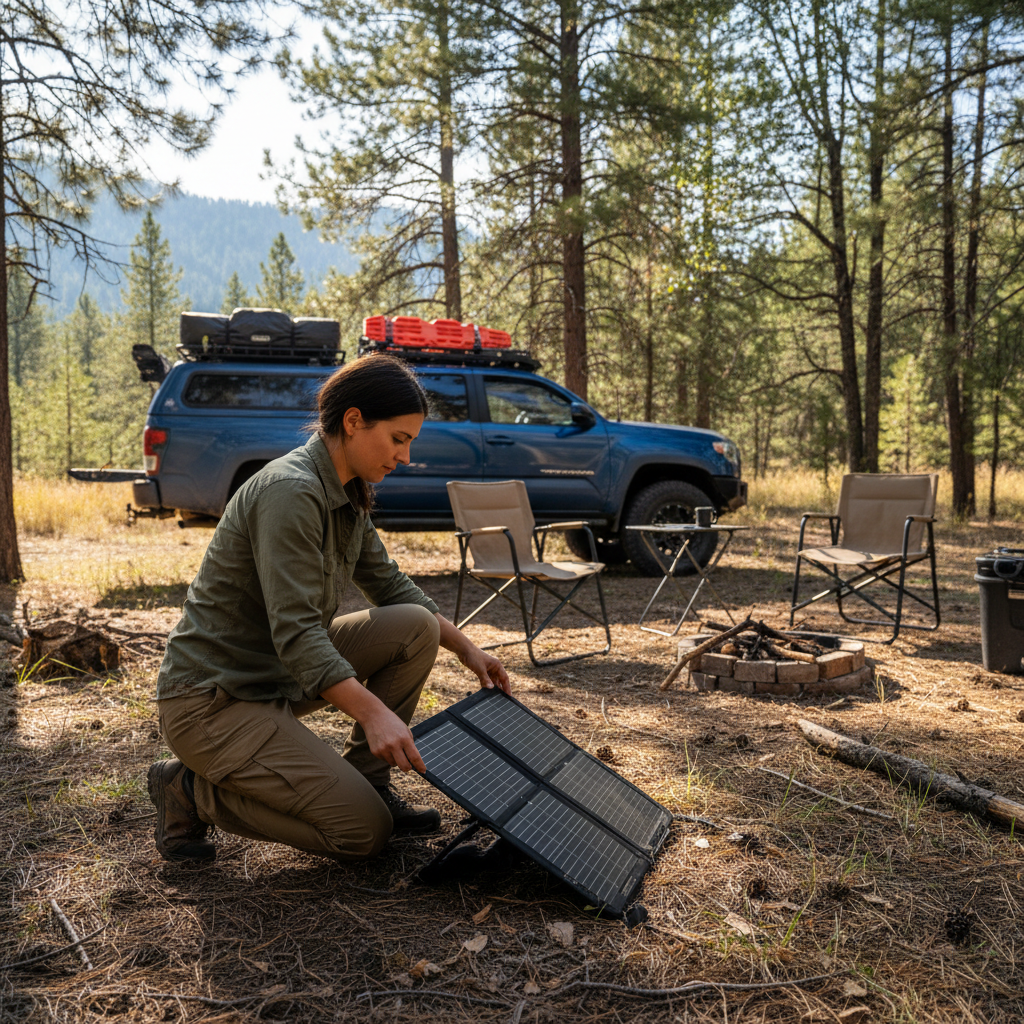
Rigid panels are laminated monocrystalline or polycrystalline cells sealed under tempered glass and mounted in an aluminum frame. They go on the roof of an RV, camper van, or truck bed rack and stay there. A foldable panel is the same cell technology (often monocrystalline) bonded to a flexible or semi-rigid substrate, then stitched or hinged into a carry case you open and angle toward the sun when you set up camp.
The efficiency numbers are close. Quality monocrystalline cells in both formats typically convert 20 to 22 percent of incident sunlight into electricity under Standard Test Conditions (STC). STC is a lab benchmark at 25 degrees Celsius and 1,000 watts per square meter of irradiance. Actual campsite output drops from that ceiling depending on panel temperature, cloud cover, and angle.
That framing misses something. The real performance gap between foldable and rigid is not in cell efficiency but in positioning flexibility. A rigid roof panel is locked to whatever angle your roof sits at relative to the sun. A foldable panel you can aim. On a partly cloudy day in the Pacific Northwest, the ability to chase a sun break by rotating the panel 30 degrees can recover meaningful charge time that a fixed panel simply cannot. The operational difference matters more than the spec sheet in casual camping conditions.
Rigid panels connected to a rooftop array also benefit from a clean, uninterrupted circuit path and, in most RV applications, are wired through a dedicated solar charge controller already built into the coach. Foldable panels require you to bring and connect that controller yourself, typically via alligator clips or an Anderson connector to the battery. It works, but it adds steps.
The Real Costs: Purchase Price, Lifespan, and the Storage Problem
A quality 100-watt foldable monocrystalline panel from established brands typically runs $100 to $200 at US retail. A rigid 100-watt panel in the same cell quality range costs roughly similar, but the installation adds $150 to $400 in mounting hardware, wiring, and labor if you are not doing it yourself. That changes the comparison immediately for someone who camps four weekends a year.
Rigid panels, once installed, carry manufacturer warranties commonly stated at 25 years for power output (with a degradation allowance, typically 0.5 percent per year). Foldable panels degrade faster at the substrate and connector level. The cells themselves hold up, but the fabric hinges, the MC4 connectors exposed to repeated plug cycles, and the carry case stitching all accumulate wear. A foldable panel used every weekend for five years is a different proposition than one pulled out a dozen times per season.
And here is the storage problem nobody mentions until it bites them: rigid rooftop panels mean your rig is charging opportunistically whenever it sits in the sun, including in your driveway between trips. A foldable panel only charges when you deploy it. If your camper van or trailer lives under a carport or in a garage, a rooftop rigid array is wasted during the 90 percent of the year most casual campers are not camping. A foldable panel stored inside between trips loses nothing to that idle time.
The math for a camper who takes eight weekend trips per year looks like this: 16 camping days of use per year, plus any driveway trickle from a rigid install. If driveway sun access is limited, the foldable panel's lower upfront cost combined with similar field performance makes the rigid install hard to justify on pure economics. That puts the rigid panel's advantage squarely in the category of convenience and durability over a long ownership horizon, not immediate value.
Which Setup Fits Your Camping Style
The honest conditional: if you camp more than 20 days per year, have a dedicated rig that lives outside and sees regular sun, and you want zero setup friction at the campsite, a rigid rooftop array is worth the installation cost. The convenience compounds over time.
If you camp fewer than 15 days per year, use a vehicle that doubles as a daily driver or lives in covered storage, or you move between vehicle types (truck one trip, borrowed trailer the next), a foldable panel is the better fit. Full stop. The install cost on a rigid system does not recover across that usage pattern.
Check watt needs, storage access, and trip frequency first. Those three inputs drive the decision more reliably than any panel spec.
There is a third group the comparison usually ignores: campers who own an RV with an existing rooftop array but want supplemental power for a site with heavy tree shade. Here, a foldable panel is additive, not competitive. You bring it along to park in a clearing while the rig sits in the shade. Both panel types coexist in that scenario, and the answer is not either-or.
One thing worth being direct about: do not buy a rigid rooftop install for a vehicle you are not committed to keeping. Uninstalling a roof-mounted array when you sell or trade the rig is a cost most buyers forget to factor in, and some purchasers discount a used vehicle with holes in the roof from removed hardware.
Where Foldable Panels Fail
Foldable panels have a real failure mode casual campers underestimate: they require you to be stationary and attentive to orientation. If you pull into a forested campsite late Friday and plan to leave early Sunday, your usable charging window may be six hours across two partial days. A rigid panel capturing ambient diffuse light all day edges ahead in that scenario even without direct sun.
They also fail campers who are simply not disciplined about setup. If your camping style involves arriving, building a fire, and not thinking about gear until you need it, a foldable panel that never got unfolded and angled is producing exactly zero watts. Buyers skip this till burned: the panel they thought would handle power needs sits rolled up in a bag because setting it up felt like a chore after a long drive.
Cold temperatures affect foldable panels disproportionately at the connector level. MC4 connectors and the cables on budget foldable panels can become brittle below freezing, which matters if you camp in the Rockies in October or the upper Midwest in shoulder season. Rigid panels in a permanent wired install are less exposed to this because connections are made once and protected inside the roof structure.
Making the Call
If you camp under 15 days a year, start with a quality 100-watt foldable panel and a basic PWM or MPPT charge controller. The upfront cost is manageable, the commitment is low, and you can always add a rigid install later if your habits change. I would start with the foldable route for exactly this reason: it tells you what you actually need before you wire anything permanent.
If you camp regularly and your rig lives outside, a rigid install pays off in convenience and long-term durability. Get a proper MPPT controller sized to your array, not the cheapest PWM unit in the box. The controller matters as much as the panel for real-world yield.
If you ignore the storage-access variable entirely and install a rigid panel on a rig that lives under cover, you have paid installation costs for a system that idles most of the year. The panel works when you camp. But so would the foldable you left in the truck bed, for a fraction of the price.