
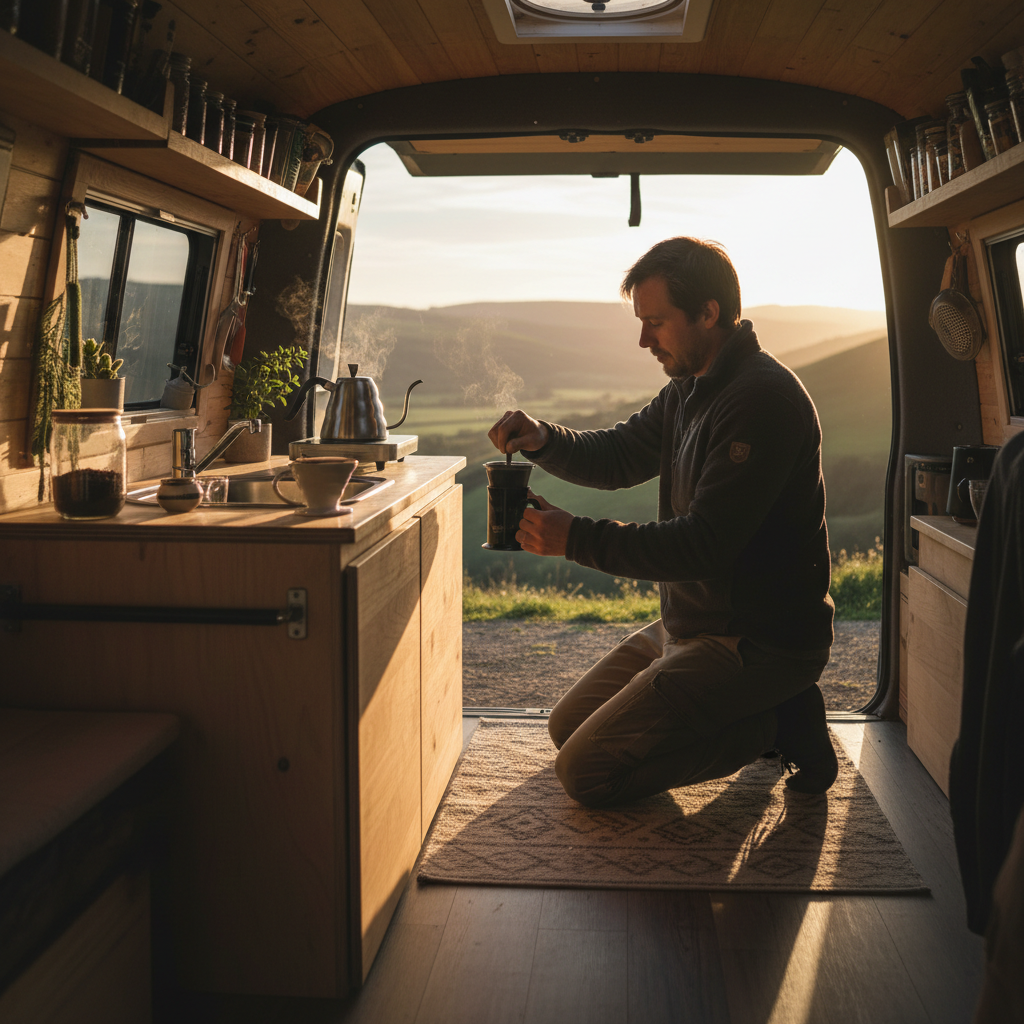
Gear reviewers will tell you to pick a coffee maker based on brew quality before they discuss anything else, and there's a reason for that: it's the wrong starting point for van life. Choosing a camp coffee maker for van life is really a resource allocation problem dressed up as a beverage preference. How much water you carry, whether your van has shore power, and how many square inches you can spare on your counter shape this decision more than whether you prefer a clean cup or a rich one.
The variables that matter most are brew method, water consumption, and power dependency. None of them are obvious from a product listing, and they interact in ways that can leave you with a beautiful brewer that sits unused because your tank runs low by noon. A pour over and a moka pot can produce wildly different results under the same vanlife constraints, not just in taste but in daily feasibility.
Here's the tension worth sitting with: the brewing methods with the most devoted followings tend to demand the most from your rig. If your water capacity is under 15 gallons or you're regularly dry camping for stretches longer than three days, that tension gets sharp fast. Most coffee content aimed at campers sidesteps it entirely.
The Real Criteria: Space, Water, and Power
Before any specific brewer makes sense, you need to size up three constraints honestly. Space is the obvious one. A van kitchen is usually 18 to 24 inches of counter at most, and a brewer that can't live in a drawer or hang on a hook is a brewer that lives on your bed.
Water is the one vanlifers consistently underestimate. A standard drip machine uses roughly 10 to 12 ounces of water per cup, but that's only the brewing water. Rinsing the carafe, warming the vessel, flushing grounds out of a mesh filter: those add up. A common guideline among full-time vanlifers is to budget double the brew volume for cleanup, so a two-cup pot draws closer to a quart from your tank by the time you're done. That's a practical heuristic, not a measured standard, but it maps well to daily reality.
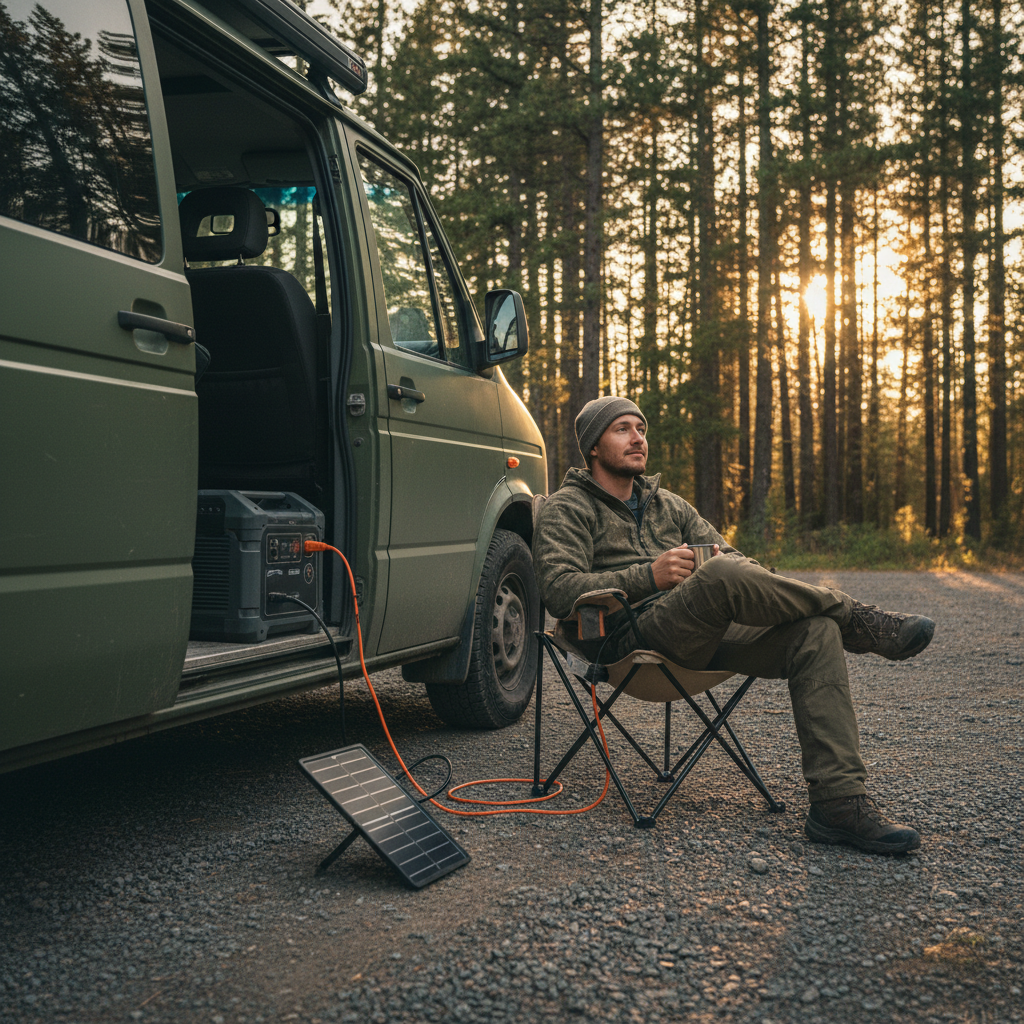
Power dependency is where the decision branches hardest. Resistive heating elements draw serious amperage. A standard 12-cup drip machine pulls 800 to 1,200 watts, which means 67 to 100 amp-hours from a 12V system per brew cycle on an inverter. Unless your van has a large lithium bank (commonly 200Ah or more) and consistent solar input, that math doesn't work. For comparison, an AeroPress or pour over uses zero electrical draw and delivers a controlled, repeatable brew in under four minutes.
Or rather: the question isn't just whether you have enough power today. It's whether you'll have enough power on a cloudy week in November parked in the Pacific Northwest, which is exactly when you want good coffee most.
Brew Method Comparison: What Each Option Actually Costs You
The table below compares the five methods you'll realistically consider. "Water use" includes a reasonable estimate for rinse and cleanup. "Power" means active electrical draw during brewing.
| Method | Water Use (2 cups) | Power Draw | Footprint | Brew Time |
|---|---|---|---|---|
| AeroPress | ~14 oz | None (hot water only) | Fits in a mug | 2-3 min |
| Pour Over (V60 or similar) | ~20 oz | None (hot water only) | Collapsible options available | 3-4 min |
| Moka Pot | ~8 oz | None (stovetop) | Compact, stackable | 5-7 min |
| French Press | ~22 oz | None (hot water only) | Fragile; 12-34 oz sizes | 4 min steep |
| 12V Drip Machine | ~28 oz | 60-120W (12V direct) | Dedicated counter space | 8-12 min |
The moka pot stands out on water efficiency. It uses less water than any other method by a meaningful margin because stovetop pressure extraction requires only the water that actually passes through the grounds: no bloom water, no vessel rinse by necessity. For vanlifers on tight water budgets or in desert Southwest climates where a 10-gallon tank might need to last four days, that difference is real. Buyers who skip this comparison often end up switching methods within three months.
The AeroPress earns its reputation not on taste alone but on the combination of compactness, speed, zero power draw, and nearly no waste. You press grounds directly into the trash, rinse with half an ounce of water, and you're done. It's the default recommendation for a reason. But it brews one to two cups per cycle, which matters if two people are in the van and one of them wants a large mug before 7 AM.
Which Setup Fits Your Rig
The right brewer depends on four things you can check right now: your water tank size, your typical off-grid stretch, your power system, and how many people need coffee each morning.
If you're running a tank under 20 gallons and regularly go three or more days between fills, the moka pot or AeroPress are your two realistic options. The moka pot wins on water efficiency; the AeroPress wins on cleanup speed and versatility (it also brews cold-concentrate if you pre-steep overnight).
Solo vanlifers with 200Ah or more of lithium storage and reliable solar sometimes run a 12V drip machine successfully, especially models built for the automotive market that draw under 80W. That setup works well when you're stationary and plugged into shore power at a campground or worksite. It becomes a pain when you're moving daily and your panels see four hours of usable sun.
Two people who both want 12 oz cups each morning should look at the 34 oz French press or a larger moka pot (the Bialetti 6-cup, a common guideline size for van use, brews roughly 9 oz of strong espresso-style coffee). The French press demands more water but rewards patience with a richer, more forgiving brew that doesn't punish you for a 30-second timing error the way a pour over can.
This article isn't for people building a full espresso setup with a semi-automatic machine and a PID controller. That's a legitimate van life category, but it requires dedicated electrical infrastructure and counter space that most van builds don't have. If that's your goal, start with your electrical system design first.
What Goes Wrong When You Choose for Taste Alone
The most common mistake is picking the brewer you love at home and assuming it translates. A pour over on a fixed kitchen counter with unlimited tap water and a gooseneck kettle is a pleasure. A pour over in a moving vehicle with a 4-gallon tank running low, parked at an angle, with a cheap camp kettle that doesn't give you flow control, is genuinely frustrating. The brew quality drops, the water waste climbs, and the ritual stops feeling like a ritual.
French press owners hit a different wall: the fragility. Borosilicate glass presses break. They break in gear bags, in cabinets that slam on turns, and when they tip off a counter. Stainless steel French presses exist and hold up far better, but they're heavier and harder to judge fill level on. If you're committed to a French press, get a stainless one from the start (GSI Outdoors and Stanley both make durable options). Buying glass first and replacing it after it breaks is a waste of money.
The counterfactual worth naming: if you don't think through your water and power constraints before buying, you'll likely own two or three brewers within your first year of van life. That's a common pattern. Each one felt right at the time of purchase and wrong within a few weeks of daily use. The cost isn't just money. It's the drawer space those unused brewers occupy and the mental overhead of a morning routine that doesn't quite work.
That framing misses something. It's not just about which brewer survives the constraints. It's about which one you'll actually use at 6:30 AM when you're cold, the propane is low, and you need to be on the road in 20 minutes. Complexity is the enemy of consistency in a small space.
The One Thing That Changes Everything
The reframe that makes the rest of this clearer: choosing a camp coffee maker for van life is less about coffee quality and more about which system has the fewest failure points on your worst day.
I'd start with an AeroPress and a small electric kettle if your van has any meaningful solar setup, or a stovetop kettle if it doesn't. Add a moka pot if water efficiency matters to you or if a second person needs a larger volume. Resist the 12V drip machine until you've lived in the van long enough to know your actual power budget across seasons.
One practical note on kettles: an electric kettle with variable temperature control (155°F for light roasts, 200°F for dark) genuinely improves AeroPress results, and a 0.5-liter travel kettle draws around 500W, which is manageable on a 200Ah system. A stovetop kettle uses propane instead and draws nothing from your battery. Both work. The stovetop version is the more resilient fallback.
Compact setups that hold up tend to share a few traits: they have no glass, no irreplaceable electrical parts, and they can be cleaned with under four ounces of water. Check those three boxes first. Brew quality, grind consistency, and cup temperature are worth caring about, but they're secondary problems. Solve the resource problem and the taste follows.
Making the Call
If your water capacity is under 20 gallons or you dry camp more than two nights at a stretch, start with the moka pot or AeroPress. Water efficiency decides this branch, not flavor preference.
If you have a solid electrical system (200Ah lithium or more, consistent solar or shore access) and two people need coffee daily, a 12V drip machine or a large French press becomes reasonable. Run the amp-hour math against your actual average daily draw before buying the drip machine.
If you're just starting out and don't yet know your rig's daily resource reality, buy the AeroPress. It costs around $35 to $45, fits in a quart-sized bag, works with any heat source, and handles both espresso-style and Americano-style brews depending on dilution. You can make a real decision in six months when you know what your actual constraints are. Start simple.