






A competent off-grid camper will size their battery bank before they ever load the cooler, and there's a reason for that. Portable fridges are among the most deceptive power draws in any camp setup: the nameplate wattage means almost nothing once you factor in the compressor duty cycle, ambient temperature, and how often you crack the lid. Get those variables wrong and you're staring at a dead battery by Saturday morning with a weekend still ahead of you.
The three things that actually determine whether your fridge survives a weekend are battery capacity, your recharging strategy, and the fridge's real-world average draw, not the peak draw listed on the box. A 50-liter compressor fridge rated at 45 watts doesn't pull 45 watts continuously. In moderate conditions it might average 15 to 25 watts, but in a hot truck bed with a warm load it can run nearly flat-out. That gap is where most people run out of power.
Here's the tension nobody talks about honestly: lithium battery banks and solar panels have gotten cheap enough that it's tempting to just buy big and stop thinking. But a poorly matched system, a 100Ah lithium paired with a single 100-watt panel and a fridge pulling 25Ah average per day, can still leave you short if you're camped in shade, driving less than two hours a day, or starting with a warm load. Capacity and generation have to be sized together, not independently.
Know Your Fridge's Real Power Draw Before You Buy Anything Else
The starting point is your fridge's actual average current draw, measured in amp-hours per day (Ah/day). Manufacturers publish peak wattage because it's the largest number and sounds impressive. What you need is average consumption under realistic conditions, and that number is almost always lower than peak but higher than the optimistic figures in reviews conducted in air-conditioned rooms.
A common guideline used by overlanding and van-life communities puts well-insulated 40- to 50-liter compressor fridges at roughly 1 to 1.5 Ah per hour at 12V in moderate ambient temperatures (65 - 75°F), which works out to around 24 to 36 Ah per day. That framing misses something. Ambient temperature swings dramatically change that figure. At 90°F ambient with a lid opened frequently and a warm initial load, consumption can climb to 2 Ah per hour or more. Budget for the hard case, not the ideal one.
Or rather: budget for your actual use case. If you're camping in the Pacific Northwest in September with your fridge in the shade, 1 Ah/hour is realistic. If you're in the Mojave in July with the fridge on the truck bed, 2 Ah/hour is closer to honest. The math that follows assumes a middle-ground scenario: 1.5 Ah/hour average, 90°F daytime ambient, fridge in partial shade. That gives you roughly 36 Ah per day as a working baseline.
This article is specifically about compressor fridges, the kind with a 12V or dual-voltage compressor that actually refrigerates. It does not cover thermoelectric coolers (the ones that just slow down warming), which have different, generally worse, power profiles and are a different product category entirely.
Sizing Your Battery: The Calculation That Actually Matters
Once you have your daily Ah figure, sizing the battery is arithmetic with one important rule layered on top: you can't use all of a battery's rated capacity without damaging it or losing the ability to run anything else in camp.
Lead-acid batteries, including AGM, should not be discharged below 50% of rated capacity. Lithium iron phosphate (LiFePO4) batteries can safely go to 80 to 90% depth of discharge. That single difference is why LiFePO4 has largely replaced AGM for serious off-grid use. It's not marketing; it's usable amp-hours per pound of battery.
Here's the derived calculation for a two-night weekend trip. Using the 36 Ah/day baseline and a LiFePO4 battery at 80% usable capacity:
- Total fridge demand over 48 hours: 36 Ah × 2 = 72 Ah
- Reserve for lights, USB charging, and other draws: add 20 Ah as a practical buffer
- Total needed: 92 Ah of usable capacity
- Required rated capacity at 80% usable: 92 ÷ 0.80 = 115 Ah
A 100Ah LiFePO4 gets you close but leaves almost no margin. A 120Ah LiFePO4 covers the scenario cleanly. If you're using AGM and applying the 50% rule, you'd need a 184Ah bank for the same real-world usable capacity, which weighs roughly 110 to 120 lbs. That's why virtually everyone running a serious camp fridge has moved to lithium. The weight and size penalty of AGM at equivalent usable capacity is prohibitive for most setups.
If you do nothing else, nail these three numbers before you buy: your fridge's average Ah/hour at your expected ambient temp, your battery's usable capacity percentage (50% AGM, 80 - 90% LiFePO4), and your trip duration in days. Everything else follows from those.
Charging the Battery: Solar, Vehicle Alternator, and Shore Power
A correctly sized battery gets you through Friday night. What powers Saturday and Sunday is your charging strategy.
The three realistic options for a weekend trip are vehicle alternator charging via a DC-to-DC charger, solar panels, or a combination of both. Shore power is only relevant if you're at a campsite with electrical hookups, in which case you could skip the battery math entirely and run the fridge directly, which is a different situation.
Vehicle alternator charging is reliable but conditional. A DC-to-DC charger (sometimes called a B2B charger) steps down and regulates alternator output to safely charge your house battery while driving. A 30-amp DC-to-DC charger running at 12V delivers about 360 watts, or roughly 30 Ah per hour of driving time. Two hours of driving per day puts about 60 Ah back into a LiFePO4 bank, which almost covers the daily fridge demand alone. The problem: many weekend campers drive less than that, especially once they're set up at a site. Relying exclusively on the alternator means your charging is tied to driving time you may not have.
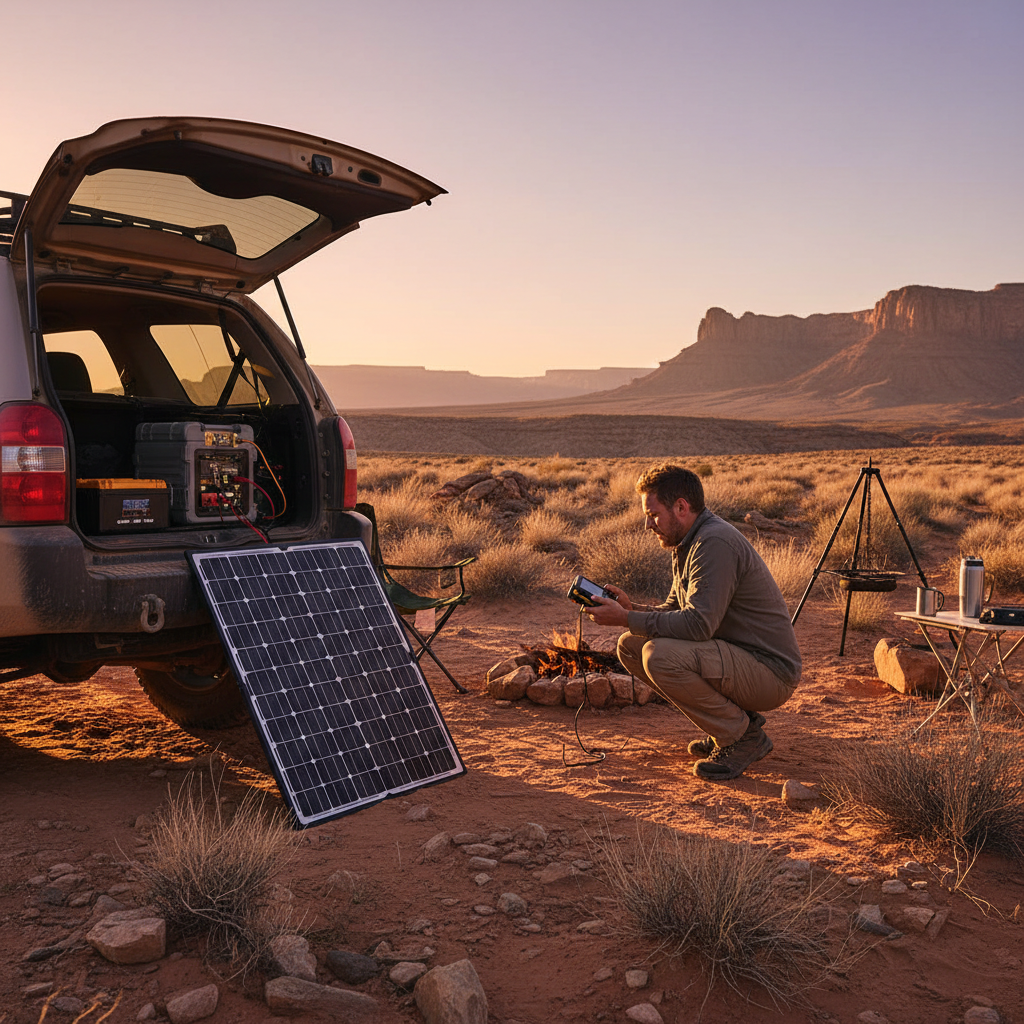
Solar adds generation while you're stationary, which is where it earns its place. A 200-watt solar panel in a location receiving five peak sun hours per day (a common figure for the American Southwest in summer; lower in forested or northern sites) generates about 1,000 watt-hours, or roughly 83 Ah at 12V, before accounting for charge controller losses. Realistic derating for partial shade, angle, and controller efficiency puts usable output closer to 55 to 65 Ah per day. That's more than enough to cover the fridge's daily draw with margin for other devices.
What most people skip until they're burned by it: panel orientation and shading matter more than panel size. A 200-watt panel in direct sun outgenerates a 300-watt panel mounted flat on a roof in dappled shade. If your setup allows it, a tilted and repositionable panel is worth more than upgrading wattage.
The combination approach, a DC-to-DC charger plus 100 - 200 watts of solar, is what most experienced overlanders run. It provides redundancy: if the solar underperforms because you're parked in trees, the drive to the next site tops the bank. If you're stationary for three days, the solar carries the load without requiring the engine to run.
Portable Power Stations: When They Work and When They Don't
Portable power stations, brands like Jackery, EcoFlow, and Bluetti dominate this category, have become popular because they're self-contained: battery, inverter, charge controller, and display in one box. For occasional campers who don't want to wire a system, they're genuinely practical.
But they come with a tradeoff that matters for a fridge specifically. Most portable power stations use lithium NMC cells, which have slightly lower cycle life than LiFePO4 and can be more sensitive to heat, a real concern if the unit is sitting in a hot vehicle. EcoFlow's Delta Pro and Bluetti AC200P use LiFePO4 chemistry, which is preferable for frequent use. Check the spec sheet, not just the brand name.
The capacity math works the same way. An EcoFlow Delta 2 carries 1,024 Wh. Running a fridge averaging 25 watts continuously draws 600 Wh per day. That's about 1.7 days of fridge runtime from a full charge with no other loads and no recharging. Add the fridge's solar input via the unit's MPPT port and you extend that meaningfully, but a single 160-watt panel (the max most Delta 2 units accept via DC input) in five peak sun hours returns roughly 640 Wh/day before losses. In theory that nearly matches daily consumption. In practice, with shading and temperature derating, count on 400 to 500 Wh. Still, that combination runs a weekend without touching reserve.
Where portable power stations fail: if you need to run the fridge for more than two days with minimal solar, or you're adding a fan, lights, and a CPAP to the load, the math gets tight fast. A dedicated 100 - 120Ah LiFePO4 battery with a proper MPPT charge controller will outperform a same-priced portable station in sustained off-grid scenarios because you can add solar capacity without replacing the whole unit.
When This Setup Fails: The Conditions That Break the Math
The sizing above works in a moderately hot, moderately sunny weekend scenario. Several conditions break it, and knowing which applies to you matters more than any specific product recommendation.
Extreme heat is the most common culprit. Fridge consumption climbs sharply above 90°F ambient, especially if the fridge is in a closed vehicle or enclosed trailer. A fridge that draws 1.5 Ah/hour at 75°F can draw 2.5 Ah/hour at 100°F. That pushes a 48-hour trip to 120 Ah of fridge demand alone, which blows past a 120Ah LiFePO4 bank with no room for other loads. If you're camping in high-heat conditions, either upsize the battery to 150 - 200Ah or shade the fridge aggressively and pre-cool it before departure.
Pre-cooling deserves its own sentence: put the fridge on shore power 12 hours before you leave and load it with already-cold food. A fridge working from a cold baseline draws dramatically less power during the critical first hours of a trip than one starting at ambient temperature. It's probably the single highest-leverage thing you can do for free.
Persistent overcast or forested camping knocks solar output down to a fraction of rated capacity. Pacific Northwest campers or anyone in dense tree cover shouldn't count on more than 30 to 40% of their panel's rated daily output. In those conditions, the DC-to-DC alternator charger becomes load-bearing, which means you need to actually drive enough to charge. If your plan is to arrive Friday and not move the vehicle until Sunday, budget conservatively and consider upsizing the battery to carry three days without significant recharge.
Anyone without a compatible DC-to-DC charger or solar panel trying to run a fridge exclusively from a vehicle's starter battery should stop and reconsider entirely. Drawing a fridge from the starter battery risks not being able to start the vehicle, which is not a comfort problem, it's a safety problem in remote locations.
Putting It Together: A Practical Weekend System
I'd start with a 120Ah LiFePO4 battery, a 30-amp DC-to-DC charger, and a 100-watt portable solar panel. That combination handles a standard two-night trip in moderate conditions with meaningful margin and costs less than many all-in-one power stations at equivalent usable capacity. It's also expandable: add a second 100-watt panel if you find solar underperforming, or add a second battery if you extend trips to four or five days.
Check these four things before your first trip: battery state of charge (top it off the night before), fridge temperature setpoint (35°F for food safety; colder wastes power with no benefit), wiring gauge from battery to fridge (undersized wire causes voltage drop and forces the compressor to work harder), and whether your DC-to-DC charger has a low-voltage cutoff that protects the starter battery. That last one isn't optional.
If you ignore the sizing math and just bring whatever battery came with your rig, here's what actually happens: the fridge runs fine Friday night, runs intermittently Saturday as voltage drops, and by Saturday evening the compressor is cycling on warm voltage and the food is at 50°F. That's not a ruined trip. It's a food safety event. Warm dairy and meat held above 40°F for more than two hours enter the danger zone according to USDA food safety guidance. The consequence of under-sizing isn't just discomfort.
The reframe that changes how you should think about this: a portable fridge isn't a convenience item you power, it's a refrigerator you've moved off-grid, and it deserves the same serious sizing thought you'd give any other appliance running continuously for 48 hours. Budget the power first. Buy the fridge second.