













Van builders will tell you that the bed decision locks in everything else before you cut a single piece of wood, and there's a reason for that. Your sleeping platform determines where cabinets can go, how the rear doors function, and whether two adults can get dressed without performing yoga. The phrase "camper van bed layouts for couples" covers a lot of ground, but the honest answer depends on three things most conversion guides treat as afterthoughts: your van's interior width at floor level, your door configuration, and how much of your waking life you plan to spend inside the van.
Here's the tension that nobody warns you about before you start building: the layout that maximizes sleeping comfort almost always compromises daytime living space, and vice versa. A fixed longitudinal bed running bumper to bumper along one wall gives you easy access and a simple build, but in a standard 148-inch wheelbase Transit or Promaster it can leave your partner crawling over you at 3 a.m. A transverse bed lets both people get in and out independently, but in a van under 66 inches of interior width it means sleeping with your feet pressed against a cabinet. Neither is wrong. Both are wrong for the wrong van.
This guide covers fixed and convertible sleeping platforms for two-person builds in vans up to around 144 to 148 inches in wheelbase. It doesn't address Class B motorhomes, high-roof Sprinters used as standing-height primary residences, or solo builds where the second sleeping position is occasional rather than shared nightly.
How Van Width and Door Configuration Drive the Decision
The single most underappreciated variable in bed layout planning is interior floor width, not overall van width. A standard Ford Transit 148 EXT measures roughly 60 inches at floor level between the wheel wells. A Ram Promaster runs closer to 65 inches in the same zone. That five-inch difference is the entire argument for or against a transverse bed for two adults.
A transverse platform, oriented side-to-side across the van's width, needs at least 54 inches to sleep two people without overhang or cramping. At 60 inches of usable floor width you're working with about 3 inches of clearance on each side for a standard queen-size mattress (60 inches wide). That framing misses something. A mattress cut to fit the van's tapered interior will lose width at the corners, and most couples report the functional sleeping width feels closer to 56 inches once the mattress is trimmed and positioned. In a Transit at floor level, transverse works, but it's tighter than the raw numbers suggest.
A longitudinal platform runs front-to-back along one side wall. Its length is less constrained by van width and more constrained by your wheelbase and the space you're willing to sacrifice for a garage or kitchen behind the bed. A full-length longitudinal platform in a 148-inch wheelbase van can comfortably reach 76 to 80 inches, which is adequate for most adults. The problem for couples is width: along one wall, with wheel wells and insulation eating into the footbox, you're often down to 28 to 32 inches of sleeping width on that side. That's a twin, not a shared bed, unless you build a raised platform above the wheel wells and extend across the full van floor.
Door configuration matters because it determines how you access the bed. Barn doors at the rear of the van (the standard on most Transit and Promaster builds) open outward and don't interfere with a transverse bed accessed from the rear. A sliding side door that opens into a mid-van kitchen means your traffic pattern runs past the bed, which works fine with a longitudinal layout but turns a transverse bed into a daily obstacle. Map your traffic pattern before you settle on a layout.
Fixed Platform Layouts: What Each One Actually Delivers
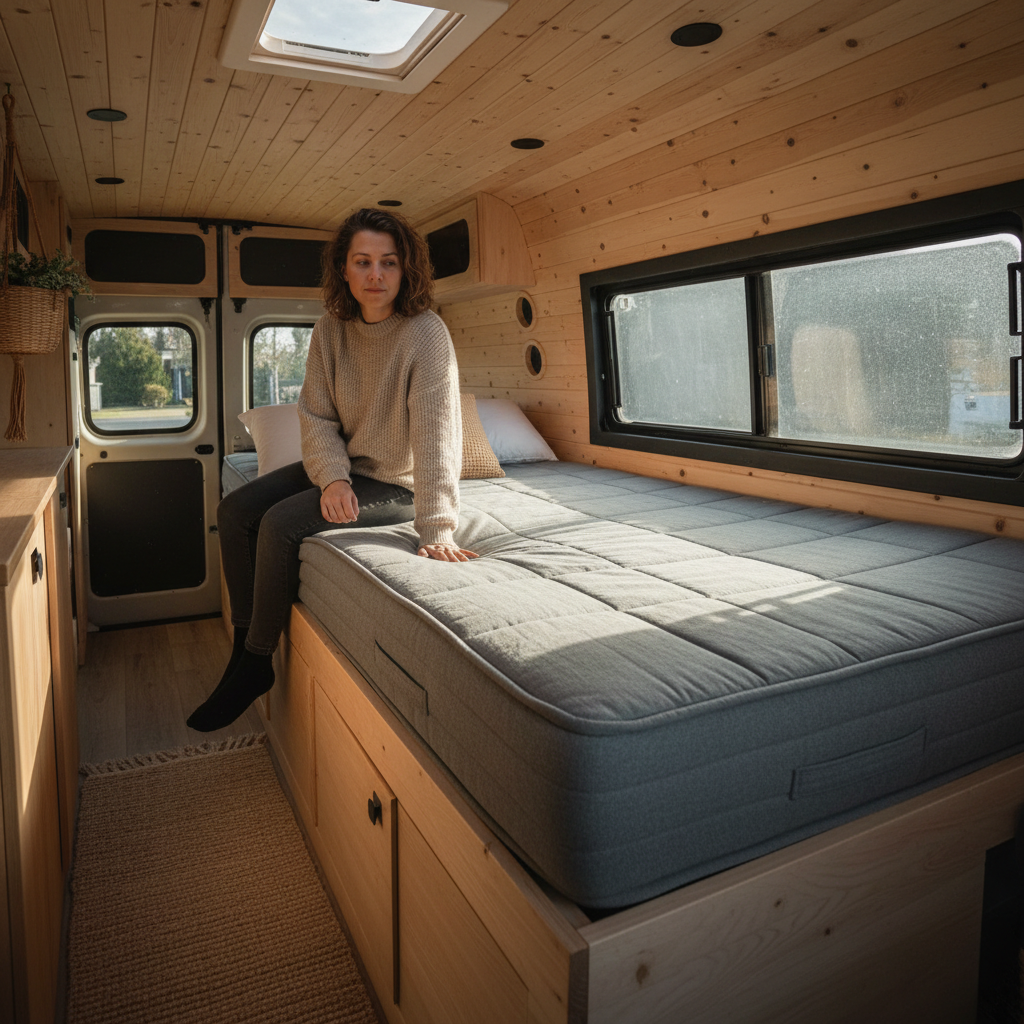
The fixed longitudinal island bed is the most popular configuration in purpose-built couple's vans, and it earns that status honestly. You build a raised platform above the rear floor, extend it across the full interior width (clearing the wheel wells with storage drawers underneath), and both people can access it from either side or from the rear. In a Promaster with 65 inches of usable width, this build can accommodate a mattress up to 54 inches wide, which qualifies as a full-size. That's not a queen, but it's workable for two people who aren't large-framed.
The tradeoff is rear access. With barn doors, you're stepping up into the bed from outside. With a sliding door mid-van, you're climbing over a kitchen counter or crawling in from the side. Neither is elegant, but most couples adapt within a week.
The fixed transverse bed places the mattress perpendicular to the van's travel direction, pushed to the rear wall. Both occupants have equal access via the side door or rear doors. This layout is especially effective in Promasters and full-size Sprinters where interior width at the sleeping zone exceeds 62 inches. It does sacrifice the rear garage entirely: the space between the rear doors and the mattress is typically only 12 to 18 inches, useful for shoe storage or a shallow gear bin but not a bike or surfboard. Couples who carry large equipment should factor that in before committing.
Or rather: it's not just about the garage. The transverse layout also changes where your kitchen and seating must go. With the bed fixed at the rear, your kitchen lands along the side wall, mid-van. That's a reasonable placement, but it means cooking with the side door open, which in winter or rain is genuinely uncomfortable. Fixed transverse works best for couples in mild-climate builds or those who cook outside by default.
A comparison of the two main fixed layouts:
| Layout | Min. Interior Width Needed | Rear Garage Access | Independent Bed Entry | Best Van Match |
|---|---|---|---|---|
| Fixed Longitudinal Island | 54 in. | Full (under platform) | Both sides or rear | Transit 148, Promaster |
| Fixed Transverse | 54 in. (62+ preferred) | Minimal (12-18 in.) | Yes (side or rear door) | Promaster, Sprinter 170 |
The island platform wins on storage access and build simplicity for most US van sizes. The transverse layout wins on equal-access sleeping and is the right call if your van is wide enough and your gear profile is light.
Convertible Layouts: The Case For and Against
A convertible bed, typically a dinette or sofa that folds flat, is the answer to the daytime living problem. You get a table for two during the day and a sleeping platform at night. The van conversion community treats this as an obvious win. I'd push back on that.
Converting a dinette to a bed every evening, and back to a table every morning, takes between 5 and 15 minutes depending on your build quality and cushion system. Over a 60-day trip, that's 10 to 20 hours of setup and teardown. If you're moving campsites daily, the math is punishing. Couples who stay in one spot for multiple nights find it much less painful, but it's still a ritual that most people underestimate when they're planning in a driveway rather than living the trip.
The stronger case for convertible layouts is in shorter vans. If you're building in a Ford Transit Connect or a Ram Promaster City, where interior length tops out around 100 inches, a fixed queen platform simply doesn't fit. A convertible dinette that becomes a 72-inch sleeping platform is often the only option that gives two people a functional kitchen and a full bed in the same small space. The NV200 and Transit Connect builds are where convertible layouts genuinely earn their place.
Buyers skip the cushion quality question until they're burned by it. A convertible bed is only as good as its cushions. Foam under 4 inches of high-density material (typically 1.8 lb/ft³ density or higher) will compress and bottom out within months of nightly use. Budget builds with low-density cushions are a pain to sleep on by month two. If you're going convertible, price the cushion system as a separate line item, not an afterthought.
When the Popular Choice Fails: The Downside Case
The fixed longitudinal island bed fails one specific couple type decisively: partners with significantly different heights or sleep needs who also prioritize daytime living space. A 76-inch longitudinal platform is long enough for a 6-foot-2-inch adult. But if one partner sleeps poorly unless they can stretch diagonally (a real and common preference), a fixed longitudinal bed oriented toward one wall gives them nowhere to go. You cannot sleep diagonally on a rectangular platform that's only 54 inches wide without falling off or pushing your partner to the edge.
The island platform also fails in any van where the build involves frequent rear-door loading. Contractors, outdoor guides, and cyclists who load bikes through the rear will find that a platform above the rear floor doesn't leave enough vertical clearance once the bed base is 18 to 24 inches off the floor. Bikes don't fit. Surfboards don't fit. The under-platform storage works for clothes and kitchen gear, not for anything taller than a drawer.
If you ignore the width variable and build a transverse bed in a Transit at floor level without accounting for wheel well intrusion, you'll end up with a mattress that's functionally 50 inches wide at the foot. Two adults trying to sleep on 50 inches for months at a time produces the kind of resentment that ends van trips early. Measure your wheel well height and width before you order a mattress.
Making the Call: A Decision Framework for Couples
Start with three measurements before anything else: interior floor width between wheel wells, interior length from the rear door to the back of your planned driver's seat, and door configuration (barn doors, sliding side door, or both).
I'd start with the width number and treat it as the primary gate. If your floor width at the wheel wells is 60 inches or less, your transverse bed will feel cramped for two adults on foam. Go longitudinal island or consider a convertible. If your width is 63 inches or more, transverse becomes viable and you gain independent bed access, which most couples report as the single most relationship-preserving feature of any van layout.
The better question is not "which layout is most popular" but "which layout survives the worst version of your trip." The worst version is a rainy week in a campground where you're inside the van for 14 hours a day. If your layout gives you nowhere to sit upright except on the bed, you'll be miserable. A fixed transverse bed with a fold-down table or a wall-mounted surface mid-van handles that scenario far better than a full-length longitudinal island with no seating position.
Check van width, door type, and gear profile first. Then pick your layout. In that order, not the reverse. Couples who choose a bed shape because it looked good in a YouTube build tour and then try to engineer the rest of the van around it consistently run into avoidable problems, from kitchen placement compromises to rear-door clearance issues they didn't anticipate. The bed is the anchor. Everything else adjusts to it.
If you're building in a Transit 148 or Promaster 136, the fixed longitudinal island platform with a 54-inch-wide mattress is the most forgiving starting point for two people. It's not the most romantic answer, but it's the one that survives the full range of conditions without requiring daily conversion work or a van wider than what's available at most US dealerships.