












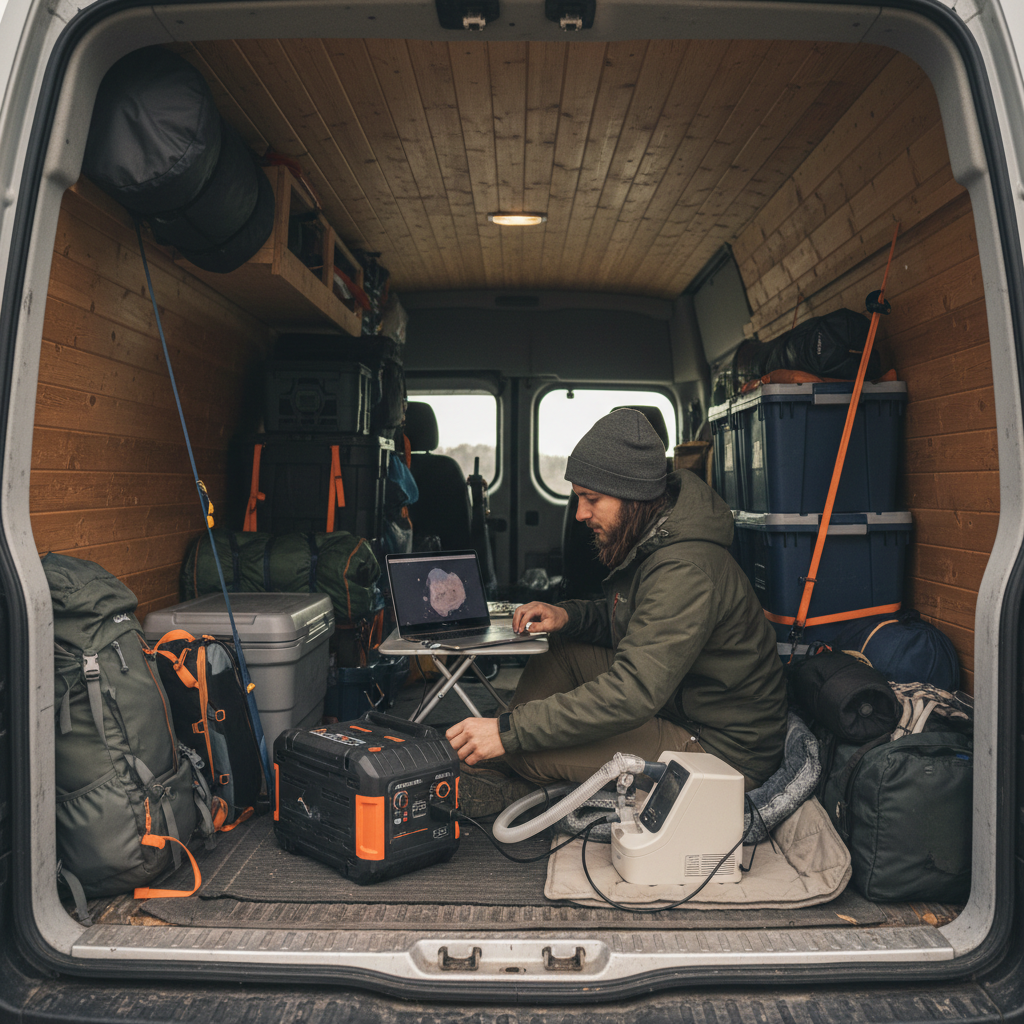
Sleep apnea patients and remote workers have roughly the same problem: both need reliable electricity in a vehicle where the factory electrical system was never designed to run overnight loads. Powering a CPAP machine or laptop in a van for a weekend sounds simple until you realize a dead house battery at 2 AM is a medical inconvenience for one and a lost workday for the other.
The core tension here is that a van's chassis battery is not a power reservoir. It's a starting battery, optimized for one large burst of current, not hours of steady draw. Treating it as overnight power storage is the single mistake that strands more van campers than any other.
Three variables determine whether your setup works: your device's watt-hour demand over the trip, your battery's usable capacity, and your recharge rate. Get any one of these wrong and the other two don't matter. A CPAP with a humidifier can pull anywhere from 30 to 100 watt-hours per night depending on pressure setting and whether you disable the heated hose, and that range alone changes what battery size you actually need.
Know Your Load Before You Buy Anything
The first number you need is your device's watt-hour draw per night, not its peak wattage. Peak wattage tells you what inverter to size. Watt-hours tell you what battery to buy. These are different questions with different answers, and conflating them is where most weekend van builds go wrong.
For a CPAP, find the watts listed on the power supply label or in the manual. A common travel CPAP like the ResMed AirMini draws around 30 watts at moderate pressure settings. Run it eight hours and you're looking at roughly 240 watt-hours. A full-size machine with a humidifier can exceed 80 watts, pushing that same eight-hour night past 640 watt-hours. Disabling the humidifier is the single most effective way to cut CPAP power demand, often by 40 to 60 percent, and most sleep physicians consider it acceptable for short trips.
For a laptop, the math is easier. Check the wattage of your charger brick, typically printed on it. A 65-watt laptop charger running six hours of actual use draws around 390 watt-hours. But laptops cycle on and off during charging, so real-world draw is usually 50 to 70 percent of that ceiling. That puts it around 200 to 270 watt-hours for a full workday.
Add those numbers together for your daily load. Then multiply by your trip length. A weekend with both devices running is a two-night calculation, not a one-night calculation. Budget for the worst night, not the average.
Or rather: budget for the worst night plus 20 percent. Batteries lose capacity in cold weather, inverters add conversion losses of roughly 10 to 15 percent, and you'll inevitably forget to account for phone charging or a fan. That buffer is not padding; it's the margin between a working system and a morning scramble.
Choosing the Right Battery
A Group 27 AGM deep-cycle battery holds around 75 usable amp-hours at 12 volts, or about 900 watt-hours before you hit the 50 percent discharge limit you should respect to protect battery life. That's enough for two nights of a travel CPAP without a humidifier, but it won't carry a full-size CPAP plus a laptop through the same period.
Lithium iron phosphate (LiFePO4) batteries change the math substantially. A 100Ah LiFePO4 battery, such as those made by Battle Born or Renogy, delivers around 1,200 usable watt-hours because you can discharge to 80 or even 90 percent without damaging the cells. They're also roughly half the weight of a comparable AGM. The tradeoff is cost: expect to pay $800 to $1,000 for a quality 100Ah LiFePO4 compared to $150 to $200 for an AGM of similar nominal capacity.
For a single weekend trip running both a CPAP and a laptop, a 100Ah LiFePO4 is the minimum I'd start with if you're not planning to recharge during the trip. If you're using a full-size CPAP with humidifier plus a power-hungry laptop, step up to 200Ah or add a recharge source.
One thing buyers consistently overlook: LiFePO4 batteries require a lithium-compatible charger. A standard AGM charger will either undercharge them or trigger protection shutoffs. This isn't a minor compatibility footnote; it determines whether your battery actually tops off between nights.
Recharging: Solar, Alternator, or Shore Power
A battery that can't recharge between nights doubles your required capacity. Recharge source is what separates a one-night setup from a multi-day system.
The three realistic options for a weekend van build are solar panels, an alternator-based DC-DC charger, and shore power via a converter. Each has a different profile.
| Source | Typical Output | Best For | Key Limitation |
|---|---|---|---|
| Solar (100W panel) | 30-50 Ah/day in good sun | Stationary camping, sunny conditions | Cloudy days or shaded parking cut output sharply |
| Alternator (DC-DC charger) | 20-40 Ah per hour of driving | Road-trip weekends with daily driving | Requires a DC-DC charger, not a simple isolator, for LiFePO4 |
| Shore power (converter) | Full recharge overnight | Campgrounds with hookups | Not available in dispersed camping or parking lots |
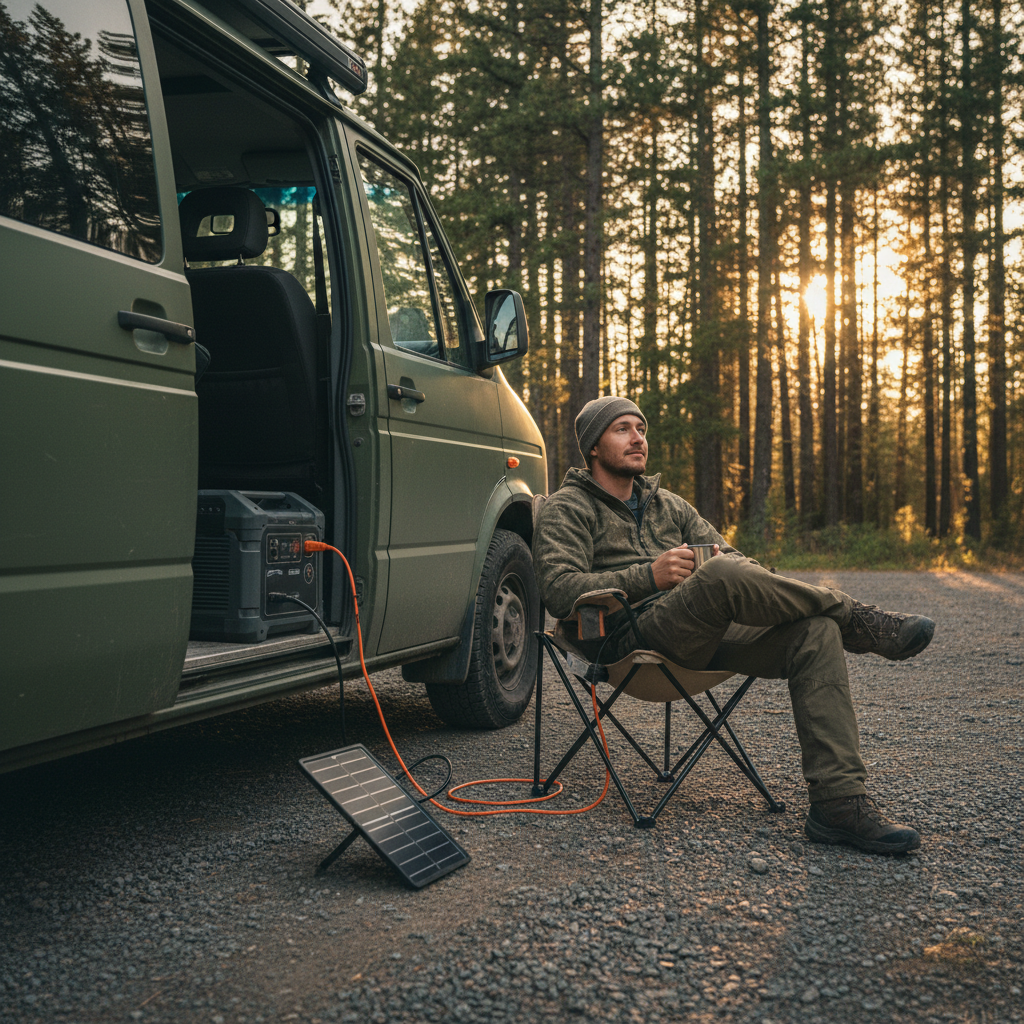
Solar is the most flexible for weekend trips without a fixed destination, but a single 100-watt panel on a summer day in the Southwest might deliver 400 to 500 watt-hours if you're parked in full sun for five hours. That nearly covers a full recharge for a 100Ah LiFePO4 battery. In the Pacific Northwest in October, that same panel might produce 100 to 150 watt-hours on a cloudy day. Plan for conditions, not ideal performance.
A DC-DC charger (also called a battery-to-battery charger) is the correct way to charge a house battery from your alternator without damaging either battery. A 30-amp DC-DC charger from a brand like Renogy or Victron adds meaningful capacity during any driving you do, typically enough to offset two to three hours of CPAP use per hour of highway driving. But using a direct isolator relay with a LiFePO4 battery can damage your vehicle's alternator under sustained load. Don't skip the DC-DC charger to save $100.
Inverters: When You Need One and When You Don't
An inverter converts your battery's 12-volt DC power to the 120-volt AC that most CPAP machines and laptop chargers expect. You need one unless your devices support direct 12-volt or USB-C power delivery.
Travel CPAPs like the ResMed AirMini and Philips DreamStation Go include 12V DC input options, which means you can run them directly from your battery through a simple DC cable and skip the inverter entirely. That eliminates the 10 to 15 percent conversion loss an inverter introduces. If you have a travel-sized CPAP, check whether a 12V DC power supply is available before buying an inverter.
For full-size CPAP machines and most laptops, you'll need an inverter. Size it to handle your peak load, not your average. A 300-watt pure sine wave inverter handles most CPAP machines and a laptop simultaneously. Pure sine wave matters for CPAPs specifically: modified sine wave inverters can interfere with CPAP motor controls and, in some cases, void the manufacturer warranty. This is not a theoretical concern; ResMed and Philips both note it in their documentation.
And modern laptops with USB-C charging are a different case entirely. Many charge natively from USB-C PD (Power Delivery) up to 65 or 100 watts, which means a quality USB-C car charger or a power station with USB-C output bypasses the inverter requirement completely. Check your laptop's charging port before assuming you need an inverter.
Portable Power Stations as an Alternative
Portable power stations like the Jackery Explorer 1000 or EcoFlow Delta 2 are worth considering if you don't want to wire anything into your van. They're self-contained units with a built-in battery, inverter, solar input, and charge management, and they cost $700 to $1,200 depending on capacity.
The realistic alternative most readers will consider is a portable power station rather than a wired house battery system. Here's the honest comparison: a portable station is more expensive per watt-hour than a DIY battery-plus-inverter setup, but it requires no electrical work, no battery isolator, and no mounting. You plug it in at home, carry it to your van, and plug your devices in. For a weekend trip, that simplicity has real value.
The downside: most consumer portable power stations use lithium NMC cells, not LiFePO4, which means they typically support 500 to 1,000 charge cycles before significant capacity degradation, compared to 2,000 to 3,000+ cycles for LiFePO4. If you're doing one weekend trip a month, that's a meaningful lifespan difference over five years. EcoFlow's Delta Pro and Bluetti's AC200P use LiFePO4 chemistry and carry better longevity, though at higher prices.
If you ignore this entirely and rely on your van's chassis battery with a cheap inverter plugged into the cigarette lighter, you will likely drain the starting battery within one night of CPAP use. A dead starting battery in a remote campsite is not just an inconvenience. It's a tow truck call.
Putting It Together for a Weekend Trip
Here's what a functional weekend setup actually looks like for two of the most common reader profiles.
For a CPAP user camping without shore power: a 100Ah LiFePO4 battery, a 300-watt pure sine wave inverter, and either a 100-watt solar panel or a DC-DC charger for recharging. Disable the humidifier for the trip. Budget under $900 for the battery and inverter if you buy mid-tier brands; add $150 to $300 for solar or the DC-DC charger. Check amp-hours, inverter wattage, and charger compatibility before purchasing.
For a remote worker running a laptop for two days: a portable power station in the 1,000 to 1,500 watt-hour range handles the load comfortably with room to spare for phone charging and a small fan. Pair it with a 100-watt foldable solar panel if you're parked somewhere sunny. Total cost lands around $1,000 to $1,400.
This article doesn't cover 48-volt lithium systems, van roof penetrations for permanent solar installs, or full electrical builds with shore power inlets. Those are multi-week projects, not weekend prep.
The reframe worth holding onto: van power for a weekend isn't about building an off-grid system. It's about matching one battery's usable capacity to two nights of known device loads, with enough recharge to not start night two already depleted.
If you're combining both a CPAP and a laptop, start by calculating your two-night watt-hour total, then find a battery with at least 120 percent of that in usable capacity. Everything else, inverter size, recharge source, power station versus wired build, follows from that number.