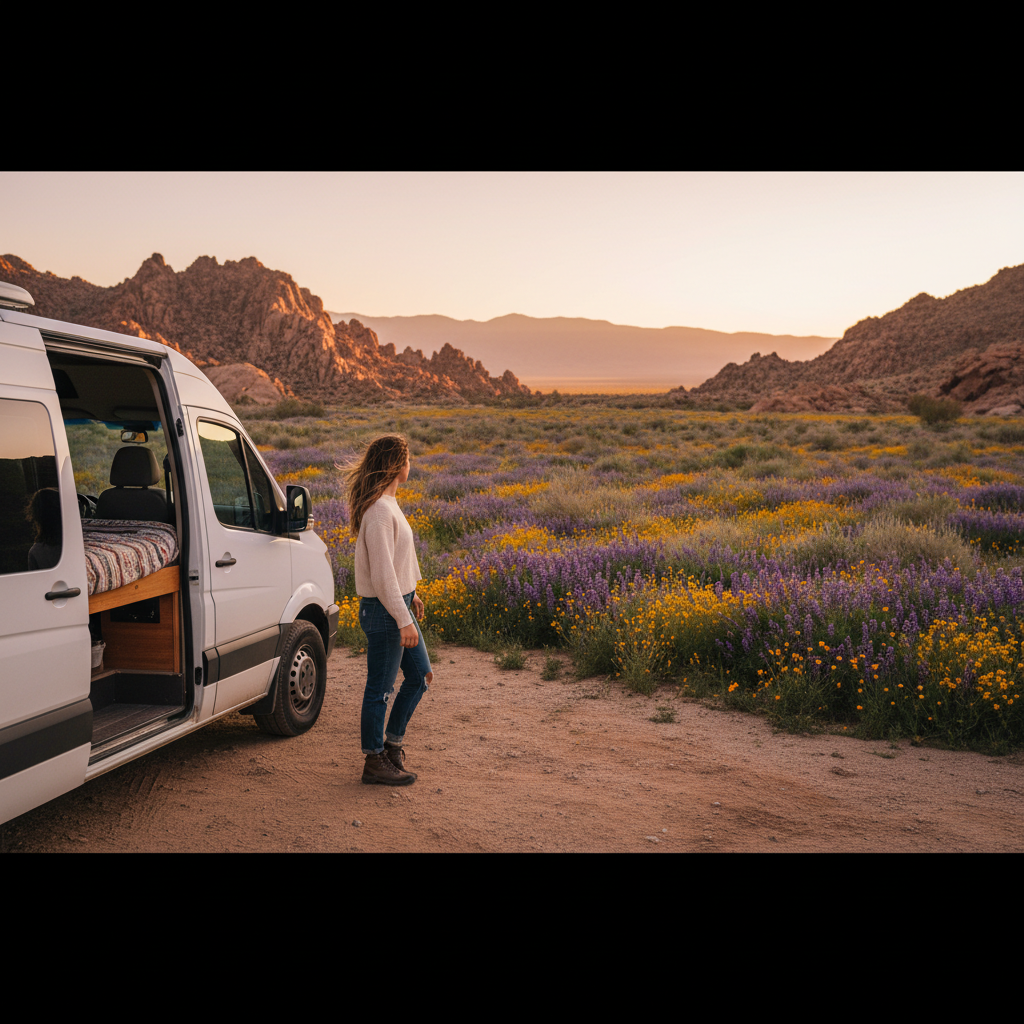




A veteran desert driver will tell you the mileage before anything else, and there's a reason for that. Two-day red-rock van loops in the Southwest look compact on a map until you account for dirt road speeds, permit windows, and the brutal math of afternoon heat that closes trailheads to anything resembling comfort by 2 p.m. in June through September. The loop that makes sense out of Kanab, Utah, is a genuinely different animal than what works from St. George or Flagstaff, and confusing them is how you end up spending your first morning backtracking on Highway 89.
The honest tension here is that the Southwest's most spectacular red-rock corridors sit inside a patchwork of BLM land, NPS units, and tribal jurisdictions whose rules don't harmonize. Dispersed camping is legal in some stretches and prohibited in others with no visible signage at the boundary. That gap is what turns a confident two-day plan into an improvised scramble by nightfall on day one.
This article is for van travelers who already understand the basics of desert camping and want a route-level argument, not a list of Instagram coordinates. If you're looking for full hookup campground recommendations or a beginner's guide to van life, this isn't aimed at you.
Why Your Base Point Determines Everything
The single biggest planning mistake on a short Southwest loop is treating all red-rock country as interchangeable. It isn't. The Kanab hub puts you within 90 minutes of Grand Staircase-Escalante's Cottonwood Canyon Road, the Wave (North Coyote Buttes permit required), and the northern edge of the Arizona Strip. The St. George hub puts you closer to Snow Canyon State Park, the Zion corridor, and Valley of Fire just across the Nevada line. Those two hubs share a color palette and almost nothing else.
Or rather: they share geology but not logistics. Cottonwood Canyon Road is 46 miles of unpaved BLM surface that turns impassable after rain with no turnaround warning. Valley of Fire's campground (Atlatl Rock) fills by Thursday afternoon on fall weekends. These aren't the same calculation.
For a two-day loop, the Kanab-based route typically outperforms the St. George alternative on raw scenery-per-mile, but it demands a higher-clearance vehicle and carries real washout risk from October through March. The St. George loop is paved or near-paved almost entirely, which means it's faster, more predictable, and considerably less dramatic. Pick your tradeoff before you pick your campsite.
If you do nothing else in the planning phase, confirm two things: whether Cottonwood Canyon Road is passable (check the BLM Kanab Field Office road condition line or their website, updated irregularly but worth checking the day before), and whether you need a permit for any specific corridor you're targeting. The Wave permit is a lottery administered by Recreation.gov and closes months out. Building a loop around it without a confirmed permit is a planning error, not bad luck.
The Kanab Loop: A Route Argument
The strongest two-day van loop out of Kanab runs south on US-89A into the Arizona Strip on day one, then north on Cottonwood Canyon Road back toward Cannonville on day two, with a night spent on dispersed BLM land in the Paria River area. This is a roughly 180-mile loop with about 40 of those miles on dirt. That puts it around six hours of driving total, leaving real time for hiking and photography on both days.
Day one logic: drop south past Fredonia, cut west to reach Toroweap (three hours from Kanab, 60-plus miles of maintained dirt, high-clearance required) only if you have a full day available and not a half-day. For a genuine two-day loop, Toroweap is too far out on its own spur. Better to spend morning hours at Paria Canyon-Vermilion Cliffs Wilderness and position yourself at a dispersed site near the Paria Contact Station before 3 p.m. BLM dispersed camping is permitted in most of this corridor outside of the designated permit zones; the contact station staff can confirm exact boundaries on the day.
Day two runs Cottonwood Canyon Road north to Kodachrome Basin State Park, which charges a day-use fee (currently around $15 per vehicle as of 2024, confirm with Utah State Parks before your trip) and offers one of the better maintained vault toilet situations on the whole loop. From Kodachrome it's a straightforward paved run back to Kanab via Cannonville and Tropic.
What you lose by ignoring this loop structure: the Paria area at dawn, which is the light condition that makes the vermilion formations earn their name. Arriving in afternoon and departing before sunrise is how most visitors experience Paria as merely scenic rather than genuinely arresting. A night on dispersed BLM land there isn't just cost-effective, it's the tactical position that justifies the whole route.
The St. George Alternative: Faster, More Predictable, Still Worth It
The St. George-based loop earns its place as the realistic alternative when road conditions are uncertain, your van is two-wheel drive, or you're traveling between November and February when Cottonwood Canyon Road becomes a genuine liability. This loop runs east through Zion's scenic byway (UT-9), north to Bryce Canyon's edge at Red Canyon, and back west via Cedar City. Alternatively it runs southwest into Nevada to Valley of Fire State Park and back in a single aggressive day-two push.
Valley of Fire is a Nevada State Parks unit, not BLM, which means dispersed camping is not an option inside the park. The Atlatl Rock campground runs around $35 per night (electric sites higher; confirm current rates at parks.nv.gov), and self-registration at the kiosk is available but sites genuinely fill by early afternoon on weekends from September through May. Call the park on day one of your trip, not the night before you plan to arrive.
The Zion corridor within UT-9 has a vehicle fee (currently $35 per private vehicle for a seven-day pass as of 2024; confirm at nps.gov/zion) and the park road from April through October is shuttle-only for private vehicles past Canyon Junction, meaning your van parks at the visitor center and you ride the free shuttle to trailheads. This isn't a hardship, but plan it into your morning schedule. The shuttle runs from roughly 6 a.m., and the first two runs of the day are meaningfully less crowded than anything after 8.
The better question is whether the St. George loop satisfies the red-rock van-trip appetite or just approximates it. Zion is spectacular; it's also the most visited unit of the Utah national parks system. Valley of Fire, by contrast, draws a fraction of that traffic and delivers fire-red Aztec sandstone formations that photograph as dramatically as anything in the Kanab corridor. For a two-day loop, pairing Red Canyon (free dispersed sites on the Dixie National Forest fringe) with Valley of Fire gives you the solitude-to-scenery ratio that most loop guides undervalue by defaulting straight to Zion.
Permits, Timing, and the Decisions That Actually Break Trips
Two permits separate a functional Southwest van loop from a frustrating one: the Coyote Buttes North permit (required for The Wave and surrounding formations, administered by Recreation.gov lottery) and any advance campsite reservation in state parks units. Both require action weeks or months before your trip, not the morning of.
The Coyote Buttes North walk-up lottery runs daily at the Kanab BLM Visitor Center at 9 a.m. for next-day entry; 10 permits are typically available (the BLM website lists current allocation, which varies). The odds vary by season but are rarely better than 1-in-8 on popular dates. Building your loop around a walk-up permit is a reasonable gamble only if you have a backup plan for the day and the flexibility to stay an extra night. That framing misses something: the walk-up lottery is actually better odds than the online advance lottery for most dates, making it the tactically smarter play if you can absorb the uncertainty.
Timing by season matters more than most two-day planning guides admit. Spring (March through May) delivers ideal temperatures but peak permit competition and afternoon thunderstorm risk starting in late May. Fall (late September through November) is the most reliable window: cooler, drier, less crowded than spring but not as empty as mid-winter. Summer above 3,500 feet elevation in southern Utah is tolerable; summer below that elevation in the Arizona Strip or Valley of Fire is genuinely hostile, with ground temperatures that can damage tires on extended parking and midday conditions that push experienced desert travelers indoors.
Check sq footage of your planned dispersed sites against your van's turning radius before committing to a spot. Narrow canyon BLM access roads often have no turnaround for vehicles longer than a pickup; a 22-foot van has ended more than a few ambitious loops at a three-point-turn in the dark.
When Two Days Isn't Enough (And When It Is)
The two-day Southwest red-rock van loop works when you define "working" as covering meaningful terrain with at least two quality hiking stops, one dawn or dusk light window, and no all-night driving. It doesn't work if your measure is seeing everything in a single corridor at depth. Zion alone rewards three days minimum. Grand Staircase-Escalante is a week-long destination for anyone who wants to hike off the roads rather than drive them.
Two days is genuinely enough for: the Kanab-Paria-Cottonwood-Kodachrome loop described above, the St. George-Red Canyon-Valley of Fire circuit, or a focused Moab-area loop covering Arches and Dead Horse Point (different terrain, same compressed-timeline logic). It is not enough for: anything involving the North Rim of the Grand Canyon as a loop waypoint, any route that requires two consecutive days of dirt road travel, or any itinerary built around a permit you don't yet have confirmed.
If you push a two-day loop into three-day territory but plan it as two days, you end up driving at night on desert roads where cattle wander onto the pavement without warning between dusk and dawn. That's not a metaphor for rushed travel. It's a literal road hazard on US-89 and US-89A that the Utah Department of Transportation acknowledges in seasonal advisories. Open range grazing makes night driving on those specific highways a genuine calculation, not a preference.
So: two days, one of the two loops above, confirmed road conditions the day before you leave. That's the version that consistently delivers what people are actually after when they search for a Southwest red-rock van trip.
Making the Most of 48 Hours
The practical summary, without the hedging:
Before you leave base: Check BLM road conditions (Kanab Field Office: 435-644-1200), confirm your target campsite's dispersed camping status, and have a paper map of the specific corridor. Cell service drops out entirely across large portions of both loops. GPS without downloaded offline maps is a real liability, not a minor inconvenience.
Day one priority: Position yourself at your overnight dispersed site or state park campground by 3 p.m. The goal is a dawn light window on day two, which means being within 20 minutes of your primary photography or hiking target before dark. Every loop described above has a high-payoff dawn location: Paria Contact Station area for the Kanab loop, Red Canyon's slot canyon trail or Valley of Fire's Arch Rock for the St. George loop.
Water and fuel: Carry more water than you think you need. The Kanab loop has no reliable water sources on dispersed land. The St. George loop has better infrastructure but still has 60-plus-mile gaps between fuel stops in the Arizona Strip. A common guideline among desert van travelers is one gallon per person per day plus a reserve gallon for the vehicle (cooling systems, dust, emergencies); treat that as a floor, not a target.
I'd start with the Kanab loop if your van has genuine clearance and you're traveling in fall. The Paria dawn light is the experience that justifies the whole Southwest van trip idea. The St. George loop is the right answer when conditions make that impractical, and it's a legitimately good two days rather than a consolation prize.
Book dispersed sites only where confirmed legal. Drive roads only when conditions are confirmed passable. And don't let the loop eat the reason you came out here in the first place.