

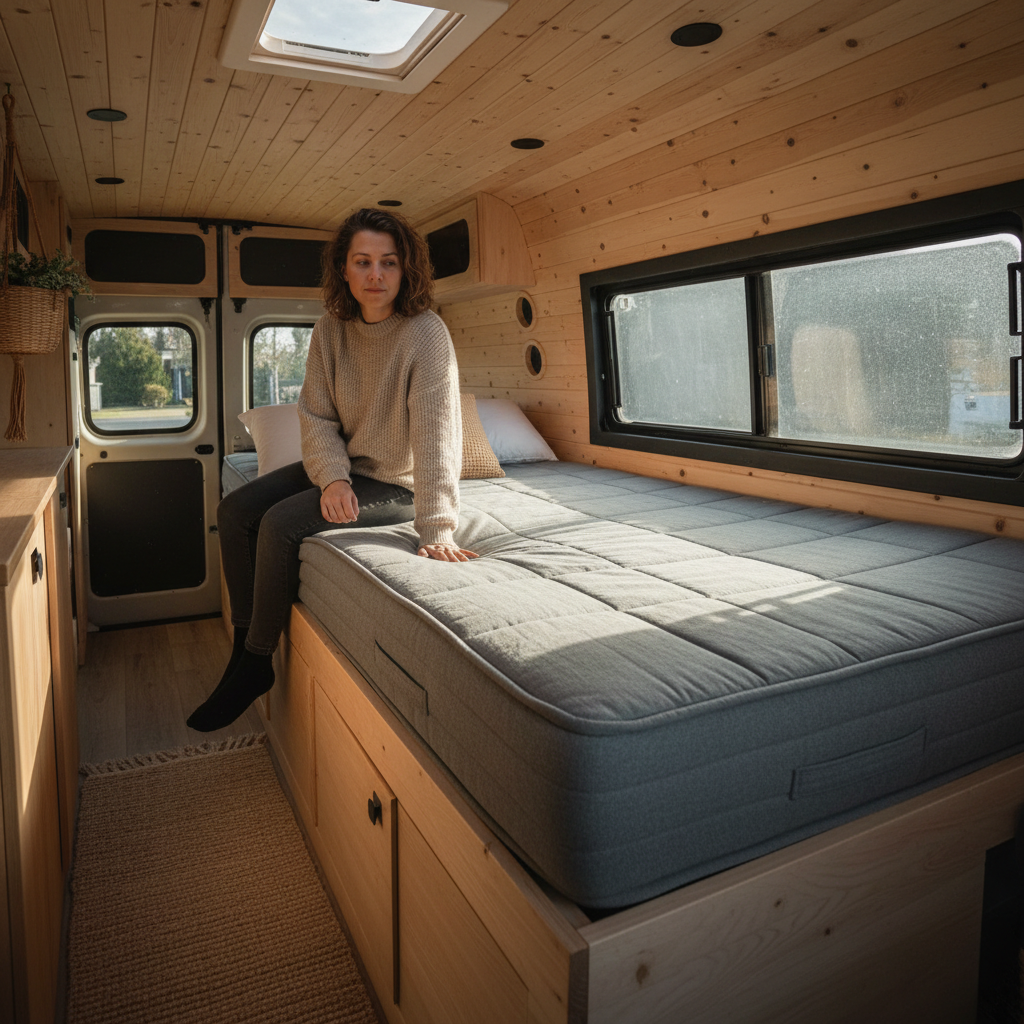









Experienced van builders will tell you to design your storage before you design your bed, and there's a reason for that. The space beneath a bed platform in a camper van is the single largest continuous volume in the build, and how you partition and access it determines whether daily life in the van is smooth or a constant low-grade frustration.
Under-bed storage in a van isn't the same problem as under-bed storage in a bedroom. You're working with a fixed floor footprint, a wheel well eating into one or both sides, and the reality that you'll be pulling gear out in a dark campsite parking lot, not a lit bedroom. The access method matters as much as the capacity.
The tension most builders don't resolve early enough: a bed optimized for sleeping comfort and a storage system optimized for daily access are genuinely in conflict. Raising the platform gains volume but costs headroom. Drawer systems give you clean access but require front clearance you may not have. Here's where that conflict plays out in practice, and how to pick the configuration that actually fits your build.
Why Access Angle Is the Decision That Overrides Everything Else
The single most useful reframe for under-bed storage: you're not designing storage, you're designing retrieval. A compartment you can't reach efficiently at 6 AM in a hoodie is dead storage, regardless of its cubic footage.
There are three realistic access geometries in a van bed build: side drawers pulling out parallel to the vehicle's long axis, rear doors or panels opening from the back of the vehicle, and top-lift platforms on gas struts or hinges. Each has a non-negotiable requirement that disqualifies it for certain layouts.
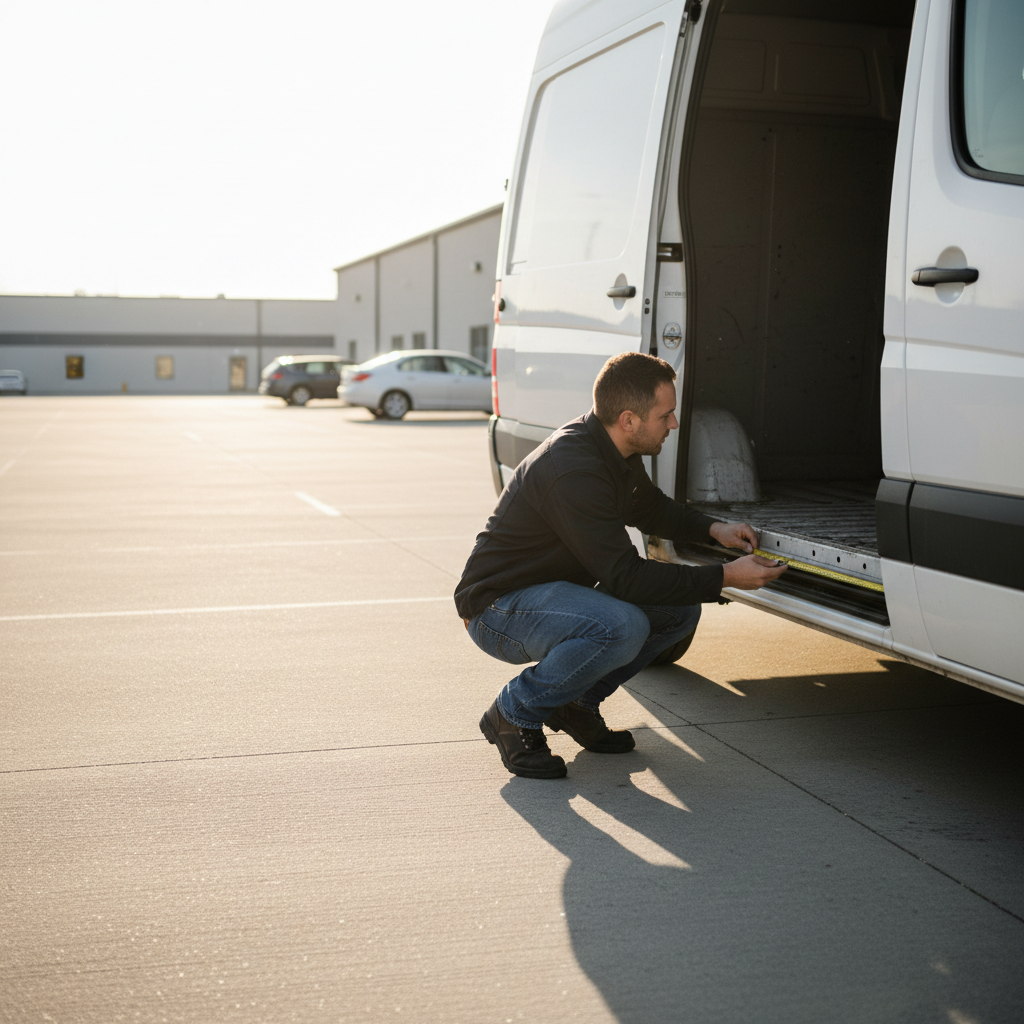
Side drawers need clear floor space beside the van, which rules them out for anyone regularly parking in tight urban spots or alongside curbs. A full-extension drawer on a 48-inch-wide platform needs roughly 30 inches of clearance to pull out completely, and that clearance has to exist on the side of the van that faces away from traffic or a wall. Builders who don't think this through end up with drawers that only open halfway.
Rear-access panels work well in cargo vans with tall rear doors, particularly in Ford Transit and Ram ProMaster builds where the rear opening is wide enough to crouch and reach forward. The drawback is that anything stored more than 24 inches from the rear edge becomes hard to grab without climbing partially into the vehicle. Good for gear you access infrequently; not great for daily-use items like cooking equipment or clothing.
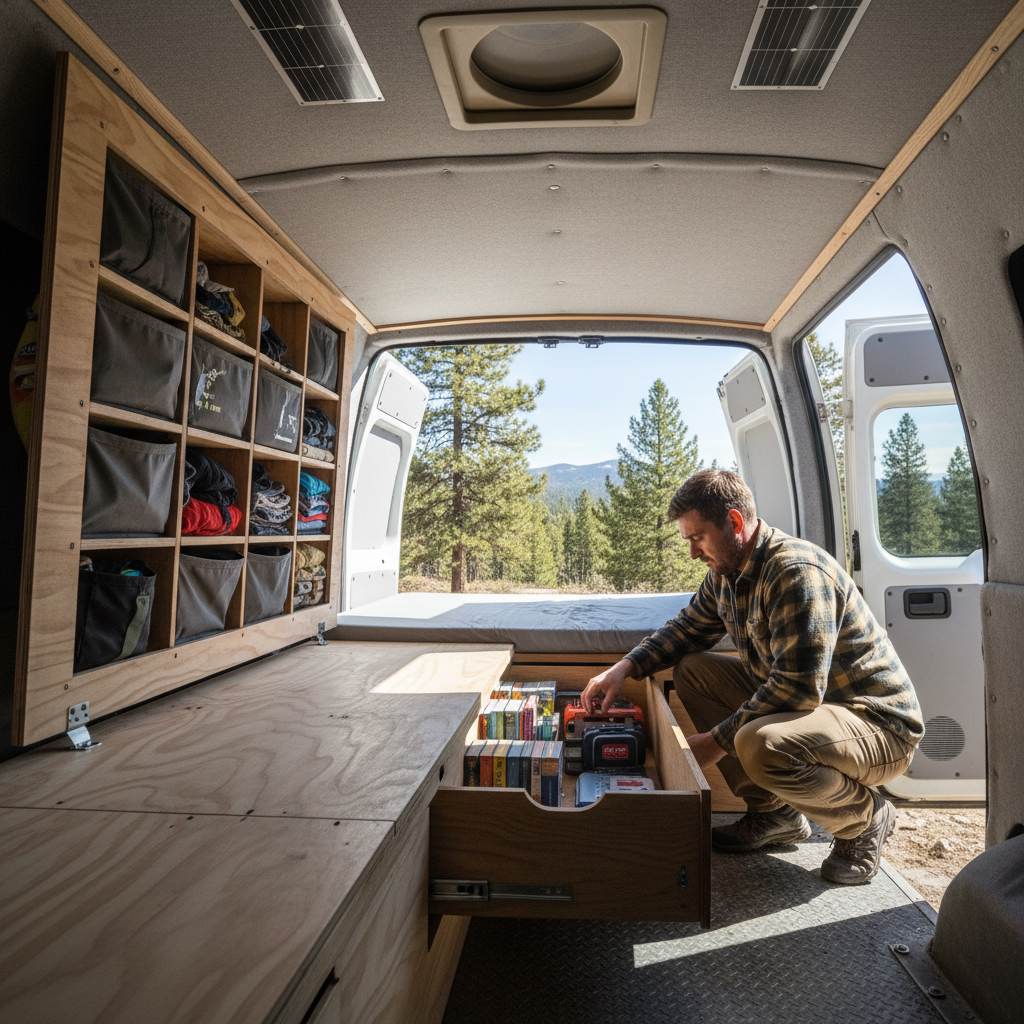
Top-lift platforms, where the mattress and a hinged or removable panel lift to reveal storage below, give you excellent access to the full volume but sacrifice the ability to access storage without getting out of bed first. That framing misses something: for most van lifers, the top-lift works fine for gear stored overnight but fails badly for anything you want mid-day without dismantling the sleeping setup. A hybrid approach, where one section lifts and another section has a side drawer, resolves this for most build types.
Platform Height, Wheel Wells, and the Math You Should Run Before You Cut
Platform height is where most first-time builders make a choice they later regret. Higher platforms mean more under-bed volume, but every inch of platform height is an inch subtracted from sitting headroom on the mattress. In a standard Ford Transit high-roof, the interior ceiling height runs around 81 inches at the center. A 10-inch platform plus a 4-inch mattress plus a seated adult requires roughly 36 inches of clearance, which means your seated head is at about 50 inches from the floor. That's fine. Push the platform to 18 inches for more storage and you've lost 8 inches of that buffer, which starts to matter for taller builders.
Or rather: the platform height decision isn't really about total volume, it's about whether the storage you're creating is actually reachable from the access point you've chosen. A 16-inch-tall side drawer cavity sounds generous until you realize the drawer box itself needs structural walls and a floor, leaving you with maybe 12 to 13 inches of usable interior drawer height. That's plenty for clothing, tools, and most kitchen gear. It won't fit a camp chair stored flat.
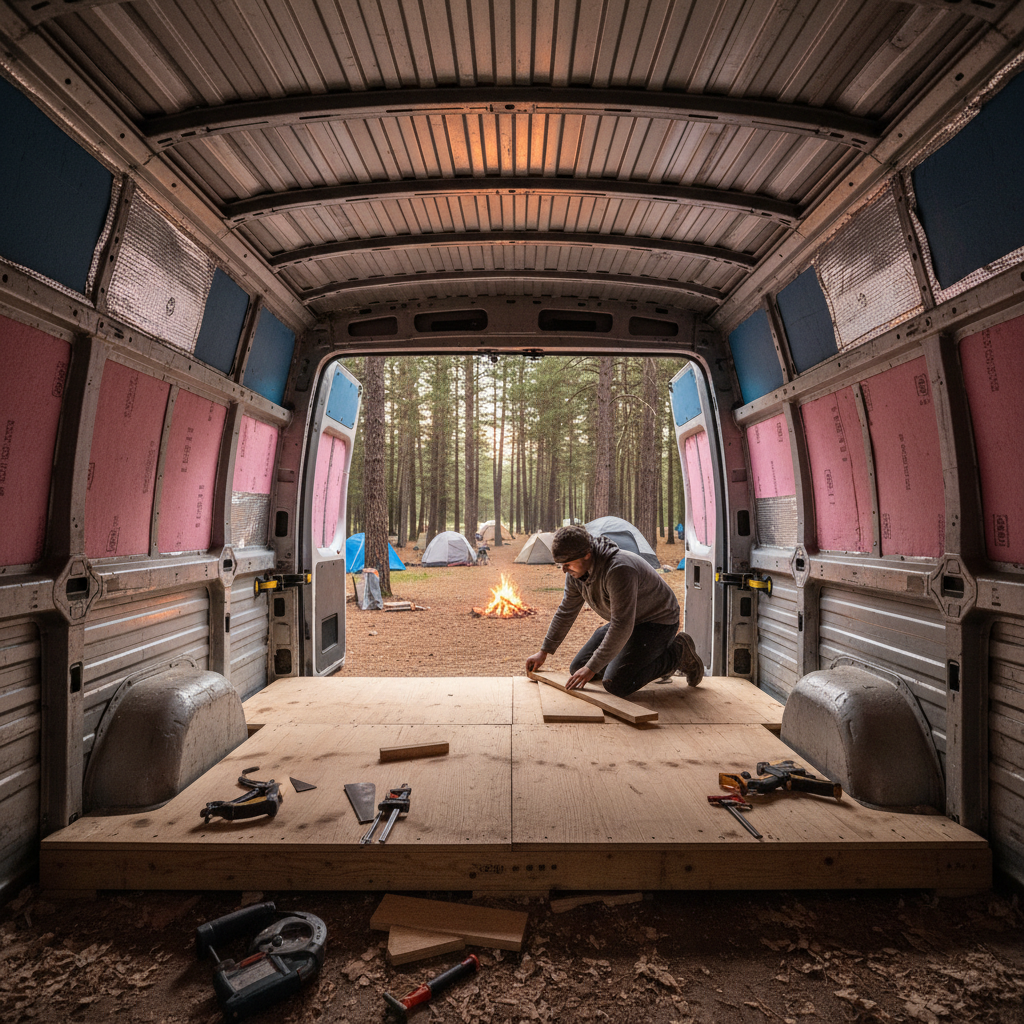
Wheel wells complicate this further. In most full-size cargo vans, the rear wheel wells protrude 8 to 10 inches inward from the cargo floor on each side. Any storage solution that doesn't account for this ends up with awkward voids beside the wheel arches that collect small items and are nearly impossible to clean. The practical fix is to box around the wheel wells deliberately, creating defined compartments on each side of the arch rather than treating the full width as a uniform cavity. Builders on the Sprinter, which has a higher wheel well intrusion than the Transit, often use the wheel well tops as dedicated shelves for flat, heavy items like tool kits and electrical components.
A common guideline in the van build community puts optimal platform height between 13 and 16 inches for most full-size vans when using side-drawer access. That's a practical heuristic based on the drawer clearance math above, not an official standard.
The Four Storage Configurations That Actually Work
Before comparing options: this section is for van builds using a fixed bed platform. Convertible beds, fold-down systems, and removable platform designs have different constraints and are outside this scope.
The four configurations worth considering for a fixed under-bed system are drawer-only, drawer-plus-lift hybrid, segmented rear-access bins, and full top-lift. Each suits a different use pattern.
| Configuration | Best Use Pattern | Primary Drawback | Typical Skill Level |
|---|---|---|---|
| Drawer-only | Daily-access items, clothing, cooking gear | Needs side clearance; no access to rear volume | Intermediate |
| Drawer + lift hybrid | Mixed: daily gear in drawers, bulky gear in lift section | More complex build; two systems to maintain | Intermediate to advanced |
| Segmented rear-access bins | Infrequent-access gear, seasonal items, tools | Poor ergonomics for daily retrieval | Beginner to intermediate |
| Full top-lift | Simple builds, van dwellers who pack and unpack infrequently | Can't access storage without disrupting the bed | Beginner |
The drawer-plus-lift hybrid consistently wins for full-time van lifers because it puts daily-access items in an ergonomically sensible location while keeping the larger storage volume accessible for less-frequent needs. The added build complexity is real, but it's a one-time cost. Builders who go drawer-only often end up retrofitting a lift section within the first year because they have nowhere to store bulky seasonal gear.
For the drawers themselves, full-extension drawer slides rated for at least 100 pounds are worth the premium over cheaper partial-extension hardware. You will bang into a partial-extension drawer in the dark exactly once and then regret saving $20 on slides. Face-frame construction on the drawer boxes adds rigidity without significant weight penalty, which matters because unsecured loads in a moving vehicle put real lateral stress on the drawer faces.
Check slide load rating, drawer box joint type, and face-frame attachment method before you commit to a drawer design. Those three factors determine whether the system holds up to daily use on rough roads.
Where Under-Bed Storage Fails and Who Should Rethink the Approach
Under-bed storage works well for van lifers with a stable home base, meaning a location where you park regularly, know what gear you need access to, and have developed routines around your retrieval workflow. It works less well for people who move constantly, sleep in different configurations, or frequently travel with varying amounts of gear.
The failure condition worth naming explicitly: if you're a part-time van user, someone who drives the van primarily on weekend trips and keeps it stored or in daily-driver use during the week, under-bed drawer systems are a poor investment. Every time you load and unload for a trip, you're fighting the fixed compartment structure rather than using flexible bags or totes that conform to whatever you're bringing. A simpler platform with open storage underneath and organized bins is faster to load and easier to reconfigure.
There's also a weight distribution issue that doesn't get enough attention. Concentrating heavy gear, think water storage, tool kits, battery systems, in under-bed compartments places significant weight over the rear axle. In a rear-wheel-drive cargo van, some rear weight bias is actually fine and can improve traction on dirt roads. But if your water tank, house batteries, and all your tools are all under the bed, you've loaded the rear of the vehicle in ways that can affect handling, especially in a top-heavy van with a roof rack loaded for an overland trip. Distributing heavier items lower and more centrally, not necessarily under the bed, is worth considering during the layout phase rather than after you've already built the platform.
Builders who skip the access-angle analysis and build drawer systems without confirming side clearance at their typical parking locations are the most common failure case. If your van usually parks at a curb or in tight campgrounds, and you didn't design for rear-access as a backup, you may find your drawers face the wall more often than not.
The Details That Separate a Good Build from One You'll Redo
I'd start with the drawer slide hardware before finalizing any other dimension. Slides determine the platform height, the drawer depth, the clearance you need at the face, and whether the whole system works on an unlevel surface. Build around your slides, not vice versa.
Ventilation inside under-bed compartments is genuinely underrated. Closed compartments in a van accumulate moisture, particularly in climates with significant temperature swings between day and night. Adding small ventilation gaps or drilling a few 1-inch holes in the back of drawer cavities does meaningful work at preventing mildew on clothing and gear stored long-term. Builders in the Pacific Northwest and the upper Midwest, where condensation in vans is a persistent problem, often add small desiccant packs inside fixed compartments as well.
Locking mechanisms on drawers matter more than they seem. A drawer that can rattle open while driving is a safety issue, not just an annoyance. Magnetic catches are fine for light drawers on smooth roads. For anything storing tools or heavy kitchen gear, a positive-latch mechanism, the kind that requires a deliberate push-to-release or a pull-up handle, is worth the extra few dollars and 20 minutes of installation.
If you skip the locking hardware and a drawer opens at highway speed, the contents hit the floor of the van and potentially shift the vehicle's center of gravity in a corner. That's not a hypothetical: it's a documented cause of load-shift incidents in cargo vehicles. This isn't an argument for paranoia, but it is an argument for positive-latch slides on any drawer carrying more than about 20 pounds.
The alternative most builders consider before committing to a built-in drawer system is modular storage: purpose-built van storage bins and boxes from brands like Decked or similar cargo management systems designed for commercial vans. These systems are significantly more expensive than a DIY platform build, often running $800 to $1,500 or more for a full setup, but they're removable, transferable to a different vehicle, and don't require any carpentry skill. For someone who isn't confident in their woodworking ability or who expects to sell the van within a few years, the modular route deserves serious consideration. The built-in drawer system wins on cost and customization but loses on portability and resale flexibility.
Making the Call: Which System Fits Your Build
If your van has consistent side clearance at your regular parking spots, you spend more than 100 nights a year in it, and you want daily access to your most-used gear without touching the bed setup, build the drawer-plus-lift hybrid. It's the most capable fixed configuration for that use pattern.
If you park in urban environments regularly, use the van part-time, or aren't confident in joinery work, use rear-access segmented bins or a modular system. The access ergonomics aren't as clean, but the build is more forgiving and easier to modify.
And if you're early in the planning process and haven't committed to a bed orientation yet: a transverse bed (running side to side rather than nose to tail) opens up full-width rear access to the entire under-bed volume, which solves the side-clearance problem entirely. It costs floor length, which in vans under 148 inches of wheelbase can mean a shorter mattress, but for shorter builders in a standard-wheelbase van it's worth running the numbers before you frame anything.