
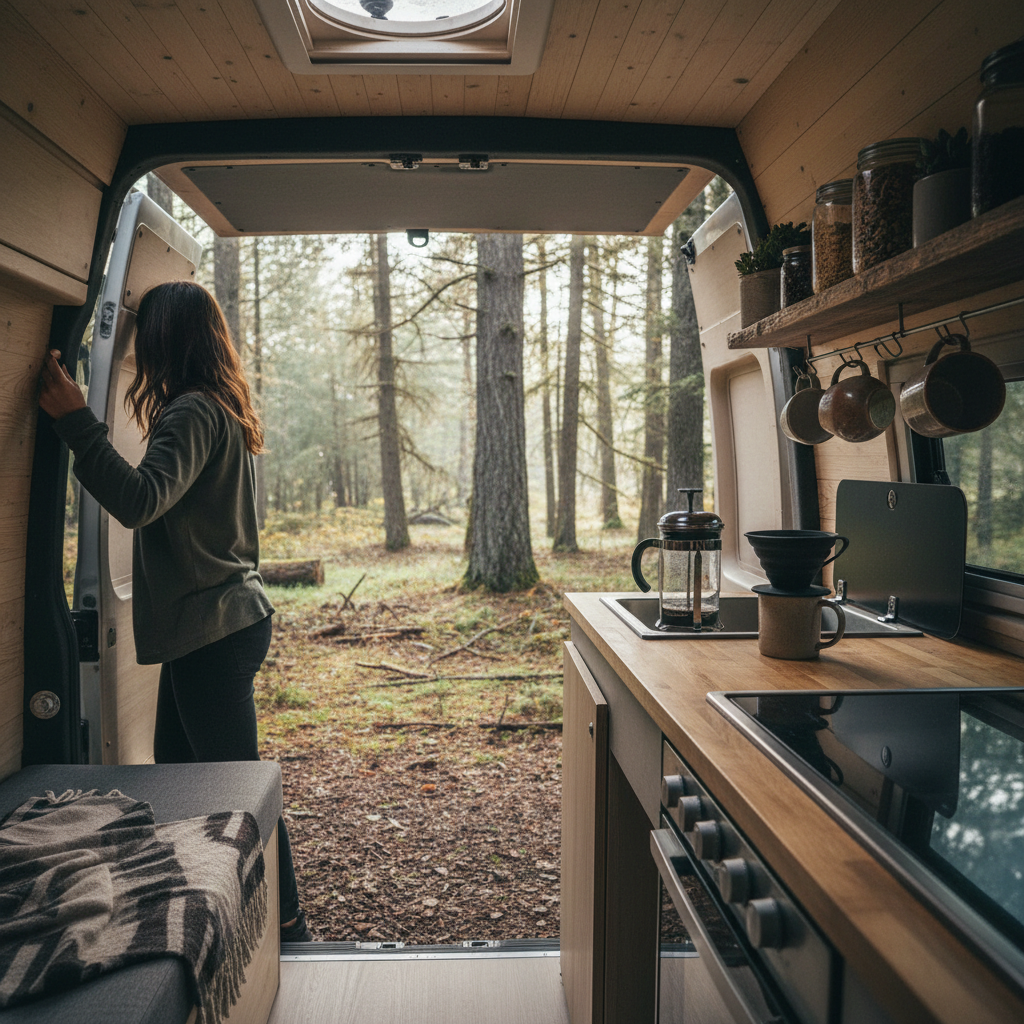
Coffee drinkers who move into a van quickly discover that the brewing method they loved at home behaves differently at 7,000 feet, in 28-degree mornings, with two liters of water left in the jug. The pour-over vs French press question isn't abstract once you're living it.
Grind consistency, cleanup water, brew time, and the weight you're willing to carry all pull the decision in different directions. Neither method is universally better for van life, and anyone telling you otherwise hasn't spent a week in the desert rationing rinse water.
There's a real tension here that most guides sidestep: the method that produces the best cup is not always the method that survives the trip. That gap between cup quality and field reliability is where the actual decision lives, and it doesn't resolve the same way for everyone.
What Actually Separates These Two Methods in the Field
The mechanism matters before the recommendation does. A French press brews by full immersion: coarse grounds steep in hot water for around four minutes, then a metal mesh plunger separates the grounds from the liquid. No paper filters, no pouring technique, no need to manage flow rate. What you get is a heavy-bodied cup with oils intact and some sediment at the bottom.
Pour-over works differently. Hot water passes through a paper or metal filter and grounds by gravity, typically over two to four minutes with a controlled pour. The paper filter captures oils and fine particles. The result is a cleaner, brighter cup with more pronounced acidity. But it depends on a steady hand, a consistent grind (finer than French press), and enough water to complete the bloom and full pour without interruption.
Or rather: the pour-over's dependency on grind size is actually a dependency on your grinder. A burr grinder producing consistent medium-fine grounds lets a pour-over shine. A blade grinder, or pre-ground coffee from a gas station bag, produces uneven particles that over-extract in patches and under-extract in others. The sediment and bitterness you blame on the method is often the grinder's fault. Most van setups skip the burr grinder to save space, which quietly disadvantages the pour-over before you've boiled a drop of water.
French press is more forgiving of grind inconsistency. Coarser grounds mean less surface area exposed, so uneven particle sizes cause less damage to the final cup. That's a practical advantage when your grinder is a hand-crank travel model or a cheap blade unit.
The Comparison: Five Criteria That Matter in a Van
These two methods look similar on a spec sheet but diverge fast under field conditions. Here's how they actually stack up across the variables that matter when your kitchen is 18 square feet.
| Criterion | French Press | Pour-Over |
|---|---|---|
| Water required (per brew) | Brewing water only | Brewing water plus rinse for filter/dripper |
| Cleanup complexity | High (grounds disposal, mesh rinse) | Low (discard paper filter, quick rinse) |
| Grind tolerance | Forgiving of coarse inconsistency | Sensitive to grind size variation |
| Altitude sensitivity | Low (immersion, timing flexible) | Moderate (flow rate changes with air pressure) |
| Gear weight | Heavier (glass models fragile, steel is safe) | Lighter (collapsible drippers under 2 oz) |
The water column tells a story by itself. If you're running a 5-gallon freshwater tank and refilling every three days, the extra rinse water a pour-over needs is genuinely meaningful. A French press brew uses what it uses and nothing more, but the grounds cleanup is messier: you can't dump wet coffee grounds down a grey-water drain or into a campsite, so you need a trash bag system or a compost setup. Pour-over paper filters, by contrast, wrap the grounds for clean disposal in a single motion.
Altitude is worth naming specifically. Above roughly 8,000 feet, water boils closer to 197°F than 212°F. French press handles this gracefully because you can extend the steep time by 30 to 60 seconds. Pour-over at altitude produces slightly different flow rates through the grounds, and if you're using a metal filter instead of paper, the extraction window shifts. Neither method fails at altitude, but French press requires less compensation.
Which One Actually Works Better for Van Life
The French press wins as the default van coffee method for one concrete reason: it demands less precision from your supporting gear. You need hot water and a timer. The pour-over wins when you have a burr grinder, reliable water access, and you care more about cup clarity than morning simplicity.
I'd start with a stainless-steel French press (glass breaks on the first hard corner) and revisit the pour-over once you know your water routine. That sequence matters. The frustration most van dwellers report with pour-over isn't the method itself; it's attempting it before their water and grinder situation is stable.
But the French press has a genuine downside that warmer-climate van life amplifies. Leftover grounds in the press continue to steep even after you've pressed the plunger. If you don't pour out every drop immediately, the residual coffee turns bitter within minutes. In a van, where you might get distracted mid-cup by breaking camp, that over-steeping is a real problem. The fix is simple: pour everything into a thermos the moment the press is done. But if you skip that step, the French press punishes you more harshly than a pour-over would.
The better question is not which method makes better coffee in a lab. It's which method makes consistent coffee given your actual morning routine, your water supply, and the grinder you're actually carrying.
If you ignore this and default to whatever you used at home, you'll likely end up with inconsistent results for the first month, blame the van, and eventually settle into one method by accident rather than by design. The difference between a functional van coffee routine and a frustrating one usually comes down to matching the method to the constraints, not optimizing the method in isolation.
When Pour-Over Is the Right Call
There's a specific van setup where pour-over outperforms French press clearly: full-time dwellers with a fixed water source (campground hookup, regular refill schedule, or a larger onboard tank of 15+ gallons), a hand burr grinder like the Timemore C2 or a similar compact model, and a preference for single-serving brewing since pour-over scales down to one cup cleanly without the waste of a half-full French press.
Collapsible silicone drippers like the Hario V60 fold-flat version weigh under two ounces and take up almost no drawer space. Paper filters add negligible weight. The entire pour-over kit fits in a quart-size bag. For van lifers who are already weight-conscious and have water figured out, that footprint advantage is real.
One more condition favors pour-over: if you're sharing the van with someone who doesn't drink coffee, brewing a precise single cup wastes nothing. A French press sized for two or four cups makes an awkward half-batch for a solo brewer. (The single-cup French press options exist but are harder to press cleanly without spillage.)
This article isn't for van dwellers with a full espresso setup or a 12-volt electric brewer. Those are different conversations with different trade-off math. The choice here is between two non-electric, low-gear options for people working within a real space and water budget.
Making Either Method Work: The Practical Short List
Whichever method you choose, three equipment decisions determine whether you'll still be using it in six months: grinder quality, water heating method, and grounds disposal plan. Get those wrong and the brewing method itself becomes a scapegoat for problems it didn't cause.
For grinder: a hand burr grinder is worth the $40 to $70 investment regardless of method. For French press, the Timemore C2 or JavaPresse Manual grinder at the coarse setting produces consistent results. For pour-over, you need the same grinders set to medium-fine, which is a finer adjustment that cheap blade grinders can't reliably hit.
For heating: a single-burner propane setup is the most common van choice, and it works well for both methods. Butane is slightly cleaner-burning indoors but requires a separate fuel system. Electric kettles with temperature control are a luxury worth considering only if you're running a solid inverter setup, since a quality gooseneck kettle draws around 1,000 watts and will drain a modest battery bank faster than expected.
For grounds disposal: keep a small compostable bag clipped inside a cabinet. Wet grounds go in, bag ties, goes in trash. That framing misses something, though: grounds are actually useful. Spread used coffee grounds at a campsite perimeter and many insects avoid the area. It's not a guaranteed repellent, but it's a practical heuristic that costs nothing extra.
And pick up enough coffee supplies for at least a week before any remote stretch. Running out of filters or propane an hour from the nearest town is the kind of preventable problem that turns a good trip sour fast.
The Decision
If your water is limited or unpredictable, your grinder is basic, or your mornings are rushed: use a stainless-steel French press, press and pour immediately into a thermos, and don't overthink it. If you have reliable water, a burr grinder, and prefer a cleaner cup: a collapsible pour-over is lighter, easier to clean, and better suited to single-serve brewing. Both methods make good coffee. Only one of them makes forgiving coffee.