




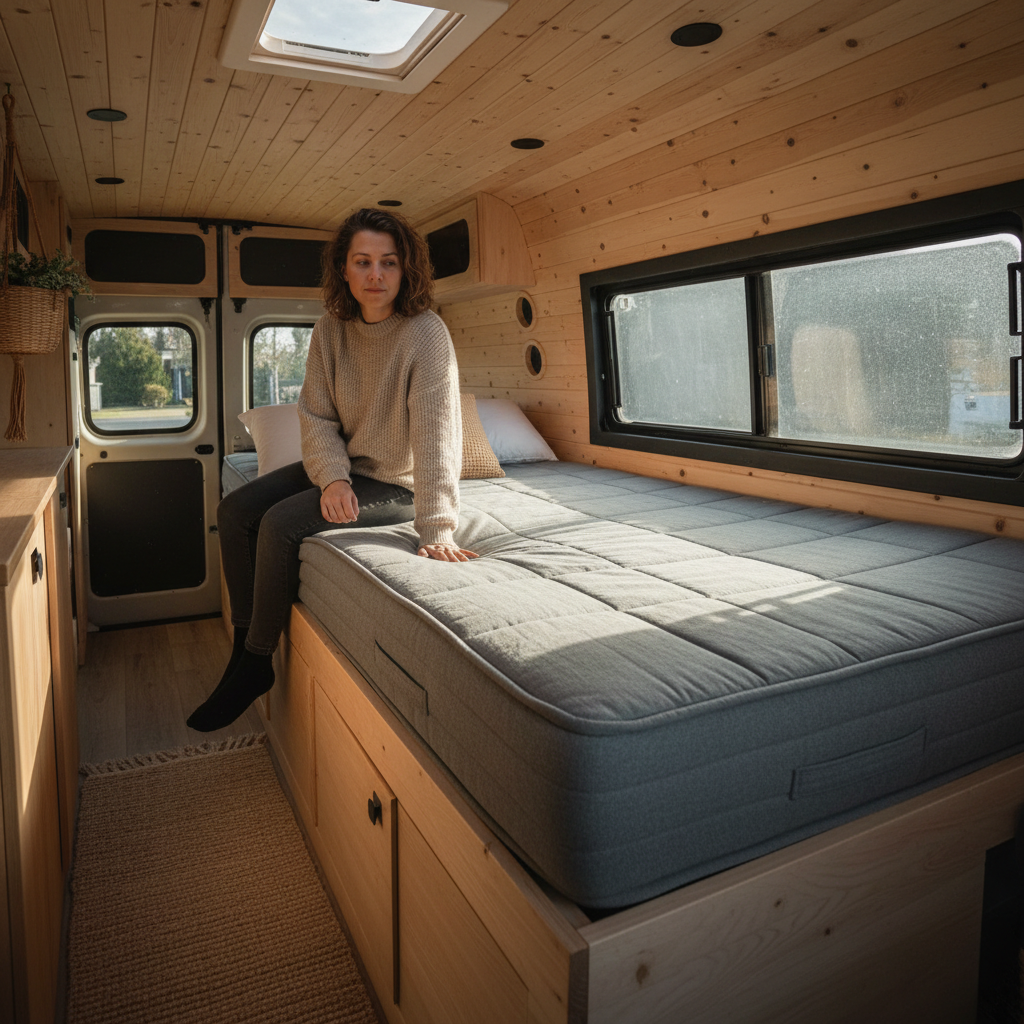











Sleep specialists will tell you that surface firmness matters less than spinal alignment before they discuss anything else, and the same rule applies inside a van just as much as it does in a bedroom. The camper van mattress you choose shapes every morning of your trip, and a bad one compounds over nights in ways a single poor hotel stay never does. Yet most people buying one for the first time treat it like a camping pad purchase rather than what it actually is: a long-term sleep system operating under unusual constraints.
Three factors separate a mattress that works from one that doesn't in a van: moisture management, thickness relative to your build platform height, and firmness matched to your primary sleeping position. Miss any one of them and you'll end up with a condensation problem underneath, a claustrophobic ceiling clearance, or a sore lower back by day four. The interaction between those three is what makes this decision genuinely tricky.
This article is for van owners building a sleeping platform or replacing an existing one. It doesn't cover RV mattresses, pop-top rooftop beds, or truck camper setups, which have different constraints and different dimensional standards. If you're sleeping in a raised-roof conversion or a full-size Class B motorhome, most of what follows still applies, but your size options open up considerably.
Why Standard Mattresses Fail in a Van
A regular bedroom mattress fails in a van for one specific reason that has nothing to do with comfort: it sits on a solid surface with no airflow underneath. At home, box springs and slatted bed frames allow moisture vapor to escape. In a van, you're almost always placing the mattress directly on a plywood platform or a closed storage box. Trapped moisture becomes mold within weeks, particularly in humid climates or during shoulder-season travel.
The second failure is dimensional. Standard twin and full mattresses are 75 inches long. Most Transit, Promaster, and Sprinter builds run 76 to 82 inches of usable sleeping length depending on wheel well cutouts, but the width at the wheel well is rarely the same as the width at the head end. A rectangular mattress that fits at the shoulders won't fit at the feet, or vice versa. That gap wastes space and forces awkward sleeping angles.
Or rather: the dimensional problem isn't just that standard sizes are wrong. It's that a rectangular mattress on a non-rectangular platform creates a forced compromise where you're either cutting foam yourself or sleeping diagonally. Neither is acceptable for a build you're spending weeks or months in.
Thickness creates a third constraint. A 10-inch mattress on a 12-inch platform leaves two inches of headroom below the ceiling. That sounds fine on paper. But if your van ceiling peaks at 50 inches above the floor and your platform sits 18 inches high, a 10-inch mattress puts your head at 46 inches, which is genuinely uncomfortable for anyone over 5'8" to sit up in. The math matters before you buy.
Foam Types: What Actually Changes Your Sleep
Memory foam, latex, and high-density polyfoam are the three materials you'll realistically choose between for a van build. Each handles the van environment differently, and the differences aren't minor.
Memory foam is the most popular choice and works well when ventilated properly. It conforms to body shape, which reduces pressure points during long nights. The downside is heat retention: traditional memory foam traps body heat, which becomes a real problem in summer van camping. Gel-infused memory foam mitigates this somewhat, though the effect fades over time. For year-round van life in the Southwest or Southeast, heat retention is a genuine concern, not a theoretical one.
Latex (specifically natural latex, not synthetic) is the strongest performer in a van environment because it's naturally moisture-resistant, doesn't off-gas, and maintains its firmness longer than polyfoam. It's also heavier, which matters when you're pulling the mattress out to access under-bed storage. A 3-inch latex topper on a 3-inch polyfoam base is a popular hybrid that balances weight, cost, and comfort reasonably well.
High-density polyfoam (1.8 lb/cubic foot or higher density) is the budget-conscious choice that works better than most people expect. Below 1.8 lb density, it compresses and sags within a season. At 1.8 lb or above, it holds its shape for several years of regular use. I'd start with a 4-inch high-density polyfoam base if budget is the primary constraint, and add a 2-inch latex topper later if comfort isn't quite there.
What you won't find in this article: innerspring and coil mattresses. They're difficult to cut for irregular van shapes, they don't fold for access to under-bed storage, and the coil pockets accumulate moisture. They're not a realistic option for most builds.
| Material | Moisture Resistance | Heat Retention | Cuttable for Custom Shapes | Typical Cost (Queen-Adjacent Size) |
|---|---|---|---|---|
| Memory Foam | Poor (requires slat base or airflow layer) | High (gel-infused: moderate) | Yes, with electric carving knife | $150 - $400 |
| Natural Latex | Good | Low | Yes, but requires sharp blade | $400 - $900 |
| High-Density Polyfoam | Moderate | Moderate | Yes, easiest to cut | $80 - $250 |
| Hybrid (Polyfoam base + Latex topper) | Good (latex layer) | Low to moderate | Yes (each layer separately) | $200 - $600 |
The cost ranges above are practical heuristics based on common retail pricing for foam sold by the sheet or roll; actual prices vary by vendor and region. Companies like Foam Factory, Foamorder, and SleepOnLatex sell cut-to-size foam that ships flat and is well-regarded in the van build community.
Thickness, Firmness, and the Clearance Calculation
Four inches is the functional floor for a van mattress. Anything thinner and most adults will feel the platform through the foam within a few nights, particularly side sleepers who concentrate body weight on shoulders and hips. Six inches is the sweet spot for most builds: enough cushion to eliminate pressure points without eating into precious headroom.
Run this before you buy anything. Measure from your finished platform surface to the lowest point of your ceiling directly above where your torso will be. Subtract your mattress thickness. That's your seated clearance. If it's below 24 inches, you won't comfortably sit up to read or eat breakfast in bed. Below 18 inches and even rolling over becomes awkward. Most Transit High Roof and Sprinter High Roof builds land between 28 and 36 inches of clearance with a 6-inch mattress, which is workable. Extended-body vans with low platforms can do better.
Firmness is more personal, but sleeping position gives you a reliable starting point. Side sleepers generally do better with medium (ILD 25 - 35 for foam, where ILD is the industry measure of foam firmness) because the mattress needs to compress under the shoulder to keep the spine level. Back sleepers can handle medium-firm (ILD 35 - 45). Stomach sleepers, who really shouldn't be stomach sleeping at all for spinal health reasons, need firm support (ILD 45+) to prevent lumbar hyperextension. If two people with different sleep positions share the van, a split configuration, two separate foam pieces side by side with a fitted cover over both, is worth the minor added complexity.
That framing misses something. Firmness preferences shift over a multi-week trip in ways they don't at home, because van sleeping usually means sleeping longer and with less position variation (limited width forces you to stay centered). A mattress that feels slightly too firm on night one often feels right by night five. Err slightly firmer than your instinct suggests.
The Moisture Problem Nobody Fixes Until It's Too Late
Van builders who skip moisture management under the mattress typically discover the problem between four and eight weeks into regular use. By then, the bottom of the foam is discolored and the platform plywood is starting to delaminate. Getting there is easy: body heat warms the mattress, moisture vapor migrates downward, hits the cold plywood, and condenses. The van environment makes this worse than a typical bedroom because temperature swings between sleeping and non-sleeping hours are larger and ventilation is lower.
The fix is an airflow layer between the mattress and the platform. Three-quarter-inch cedar slats spaced two inches apart is the traditional approach and still works well. A simpler option that's gained traction in the van build community is a product like the Hypervent mattress underlay (originally designed for boats) or similar open-cell polyethylene mesh mats sold at marine supply stores. These create a consistent air gap without requiring any woodworking skill.
Whatever you use, pair it with a wool mattress protector on the top surface. Wool wicks moisture away from the sleeping surface, resists mildew, and regulates temperature better than synthetic protectors. It's not cheap (expect $80 - $150 for a quality wool protector sized for a van), but it's cheaper than replacing foam that's been compromised by moisture.
If you skip the airflow layer entirely? The foam stays wet, mold spores establish within a month in humid conditions, and the health implications of sleeping on a moldy surface are not minor. That's not a scare tactic. It's what happens.
Custom-Cut vs. Off-the-Shelf: When Each Makes Sense
Off-the-shelf mattresses work when your sleeping platform is genuinely rectangular and close to a standard dimension. A 38×75 inch twin XL fits a short-side sleeping platform in many Transit 148 Extended builds without modification. If your build is that clean and your wheel well cutouts don't intrude on the sleeping area, a standard mattress saves time and money.
Custom-cut foam is the right call in three situations: your platform has wheel well cutouts that create an irregular shape, you want a fold-in-the-middle design to convert the sleeping area to a seating area during the day, or your platform is unusually narrow or wide compared to standard dimensions. Companies like Foam Factory and SleepOnLatex will cut foam to your exact template for a modest additional fee. The process is straightforward: trace your platform on cardboard, photograph it with dimensions marked, and send the file. Turnaround is typically a week.
The one trap with custom foam: don't order it before your platform is actually built. Measure twice, then measure again after the platform is finished and any edge banding or flooring is installed. A quarter-inch gap on each side of a custom-cut mattress feels sloppy and lets the foam shift during driving. A quarter-inch interference means the mattress won't fit at all. Order after the build is done.
Buyers who skip the custom route and try to fill gaps with throw pillows almost always regret it after the first week. The pillows migrate, the gap becomes a sleep problem, and eventually the mattress ends up replaced anyway. Get the dimensions right from the start.
The One Situation Where This Whole Approach Changes
Everything above assumes a fixed sleeping platform that stays in place. If your build uses a convertible day-to-night configuration, where benches or a dinette fold flat to create a sleeping surface, the foam requirements are completely different.
Convertible setups need foam that folds or stacks without permanent creasing. High-density polyfoam above about 2.5 lb density is too stiff to fold cleanly and will develop stress fractures at the fold line within months. For convertible builds, the standard approach is thinner foam (3 inches maximum) or a segmented design with three separate cushion pieces that stack rather than fold. Comfort suffers relative to a fixed platform with 5 - 6 inches of foam, but it's the honest trade-off.
Natural latex in a convertible setup is a poor choice for the same reason: it's heavy and doesn't fold gracefully. Memory foam handles folding better than latex but develops fold-line compression over time. If you're committed to a convertible layout and want reasonable comfort, a 3-inch memory foam topper over the cushion base, stored rolled during the day, is a workable solution. It's not ideal. Fixed platforms sleep better.
What to Buy and in What Order
Start with the airflow layer, not the mattress. Get that right first because it determines platform height, which determines how much mattress thickness you have to work with. Cedar slats or a marine-grade mesh underlay, installed before you measure for foam.
Then measure your finished platform: length, width at head end, width at foot end (these are often different), and wheel well cutout dimensions if applicable. If the shape is irregular, make a cardboard template.
For most fixed-platform builds, a 4-inch high-density polyfoam base (1.8 lb density minimum) topped with a 2-inch natural latex layer gives the best balance of cost, durability, moisture resistance, and comfort. Total thickness of 6 inches fits most high-roof builds with adequate clearance. Order from a foam supplier that cuts to size rather than buying a precut mattress and trimming it yourself. Cutting high-density foam cleanly requires an electric carving knife or a band saw; razor knives leave ragged edges.
Add a wool or organic cotton mattress protector before your first night. Check: foam density, ILD rating, airflow layer installed, clearance calculation done. In that order.
If you're replacing an existing mattress that developed moisture problems, inspect the platform before ordering new foam. If the plywood has surface mold, sand it back and treat it with a diluted white vinegar solution (a common DIY approach, though a mold remediation product designed for wood is more reliable for established mold). Installing new foam on a compromised platform restarts the clock on the same problem.
Final Call
If your build is fixed-platform with a high roof, get 4 inches of 1.8 lb polyfoam plus a 2-inch natural latex topper, cut to your exact platform dimensions, on top of a mesh or slatted airflow layer. That combination handles moisture, lasts multiple seasons, and adapts to most sleeping positions without compromise.
If your budget limits you to foam only, go full 6-inch high-density polyfoam at 1.8 lb or above. Don't go thinner to save money; the comfort degradation over a week-long trip is real and it won't be worth it.
If you have a convertible layout, accept that comfort is constrained by the configuration and use 3-inch segmented cushions rather than trying to make a thick foam work in a folding design.
The one thing that doesn't have a workaround: skipping the airflow layer. No mattress material survives direct contact with an unventilated plywood platform in regular use. That step isn't optional.