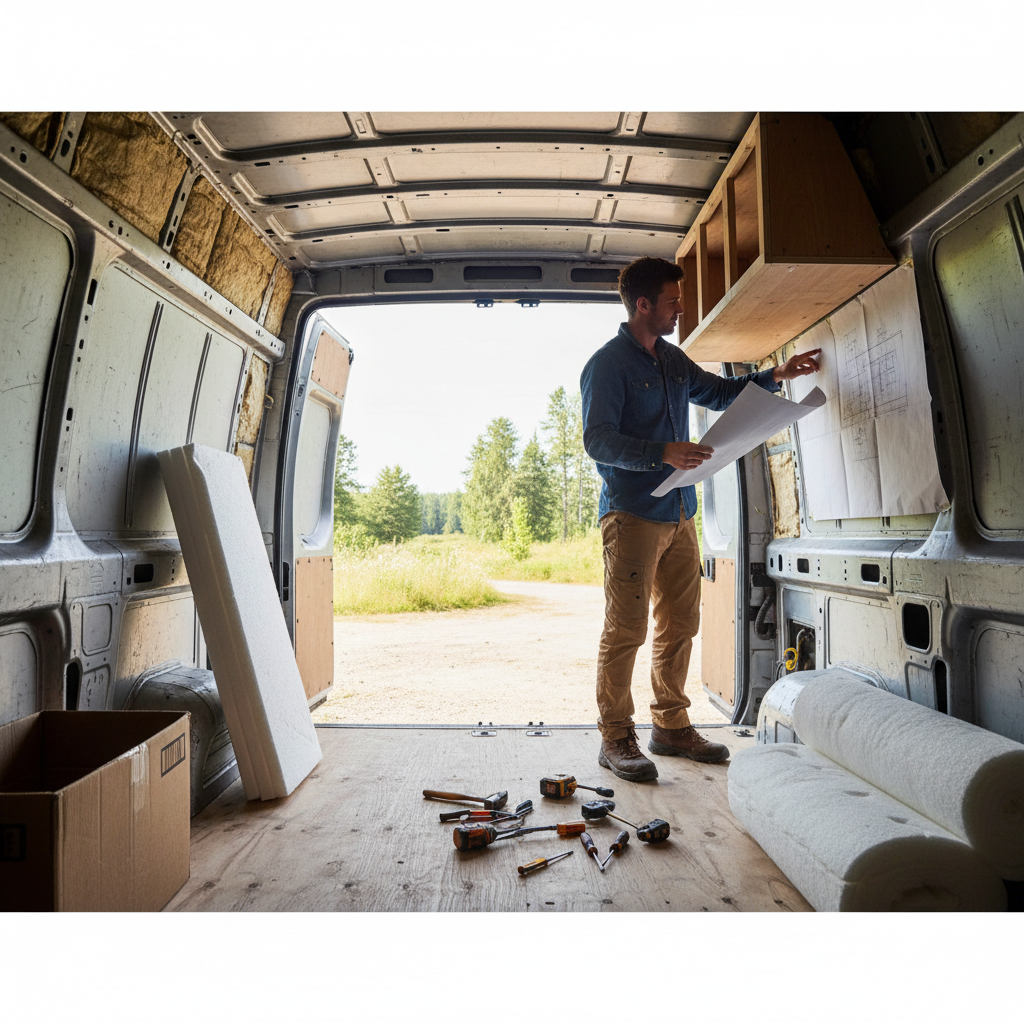
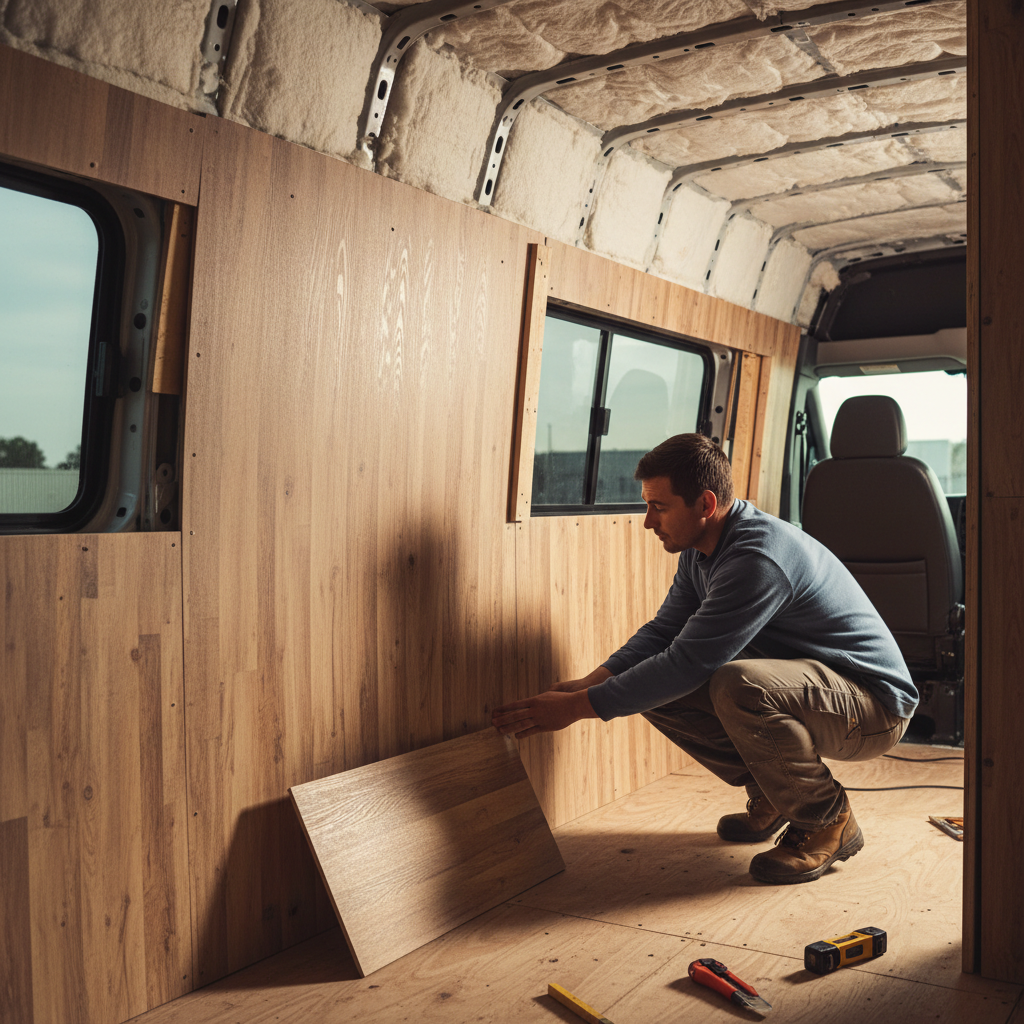
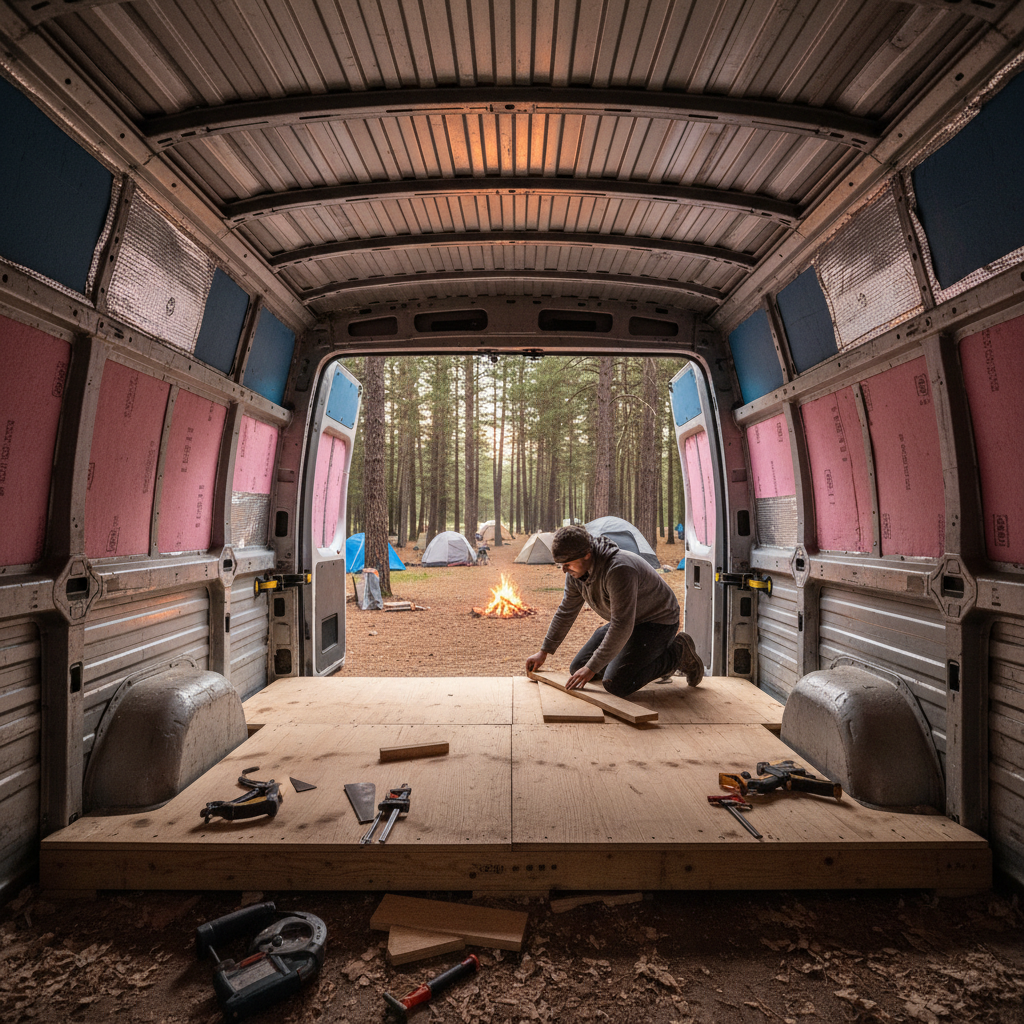


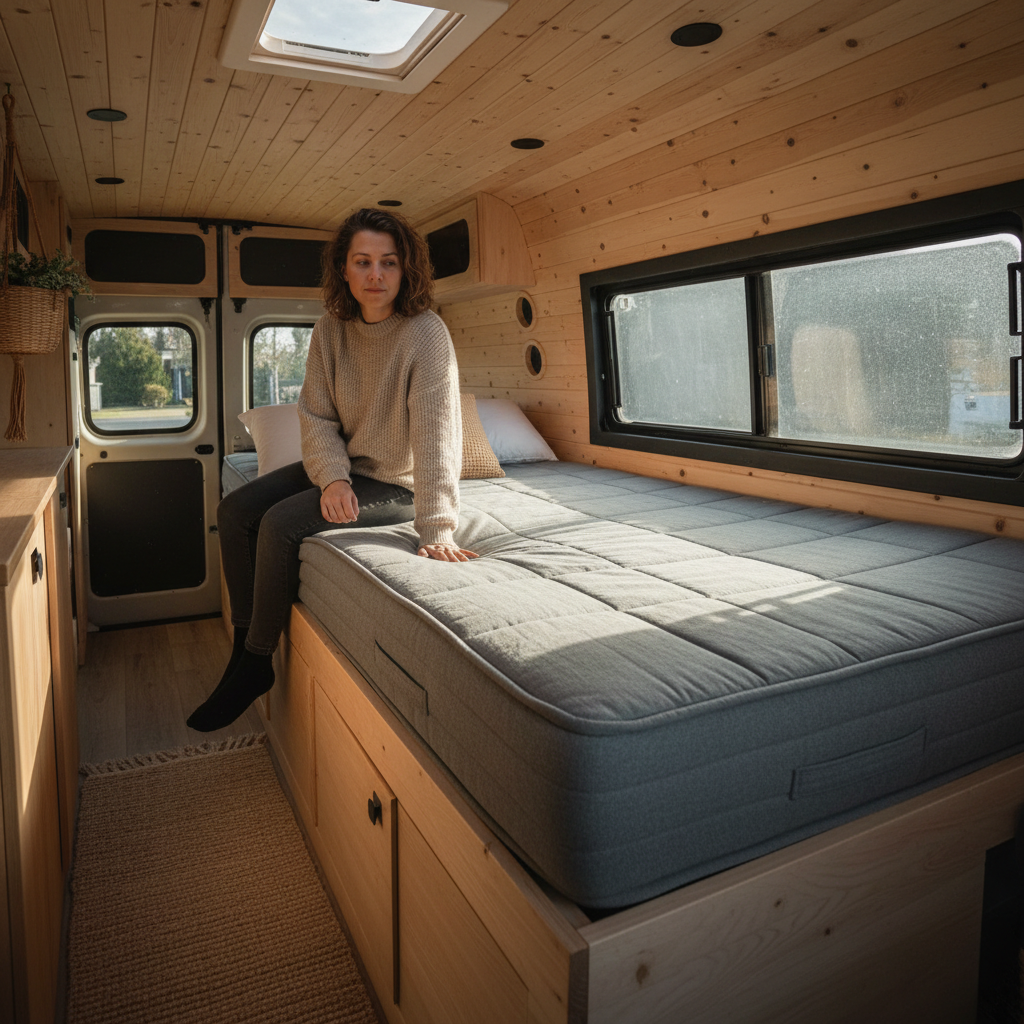










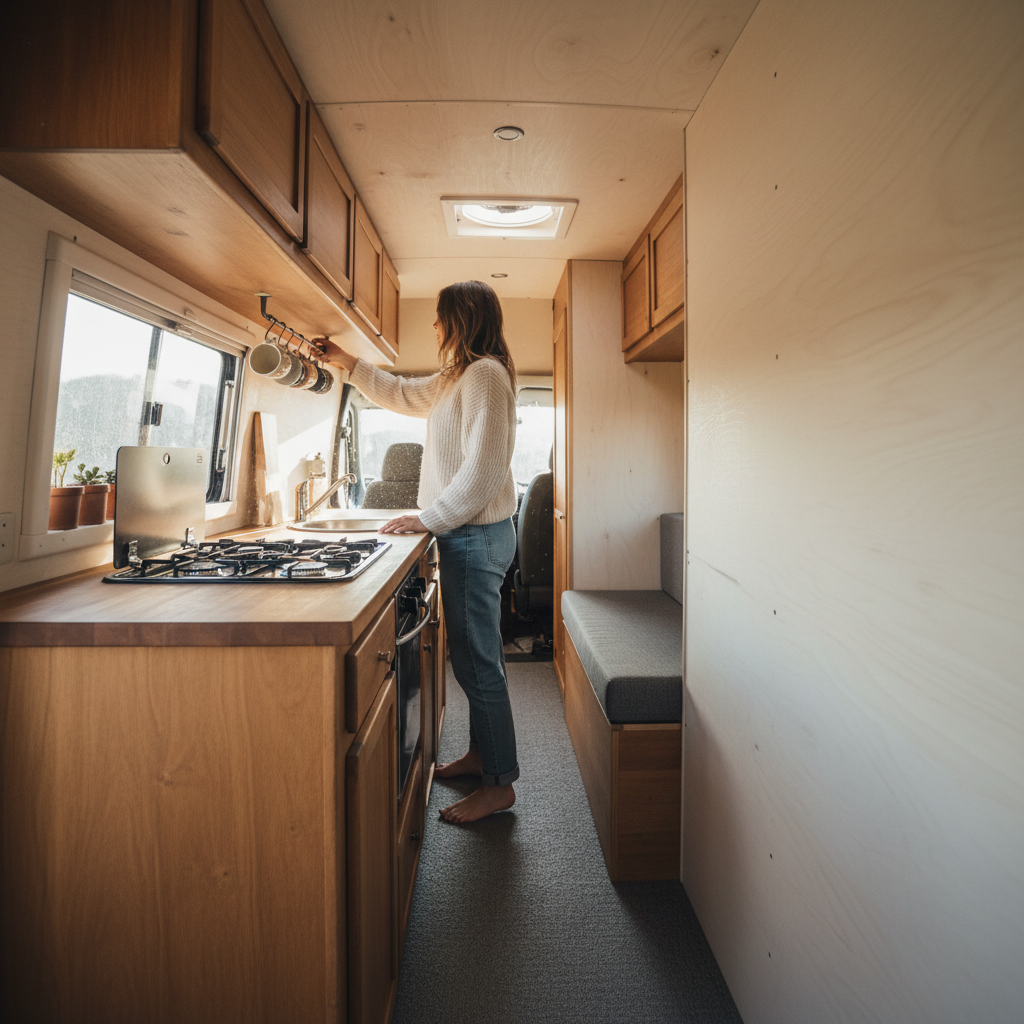
Van converters and small-trailer builders will tell you the galley position is their first structural decision, before the bed, before the electrical, before anything else, and there's a reason for that. Once the galley anchors the floor plan, every other component falls into a fixed relationship with it. Change the galley after the fact and you're essentially rebuilding from scratch.
Choosing between a rear galley and a side galley in a small camper isn't really about preference. It's about how your specific rig's dimensions interact with the way you use a kitchen. Rig width, the orientation of your sleeping platform, whether you cook inside or outside, and whether one person or two people use the space simultaneously all push the answer in different directions.
Here's the tension nobody addresses clearly: the rear galley gives you the longest continuous countertop a small build can offer, but it eats the one wall where a cross-ventilating window would normally go, and in a sub-100-square-foot space, that trade-off hits harder than most build guides let on.
What Each Layout Actually Does to Your Floor Plan
A rear galley runs the kitchen across the full back wall of the camper. In a van or small trailer, that typically means 48 to 60 inches of linear counter space, depending on rig width. Everything stacks efficiently: fridge on one end, sink in the middle, stove on the other. You walk into the kitchen from a single aisle, which means the cook has a clear sightline to the door and good reach across the entire prep surface without moving their feet.
That sounds ideal. Or rather: it sounds ideal until you think about how cross-ventilation works in a sealed box. Rear galleys sit directly opposite the main entry door, which is the primary air path in almost every van and small trailer. Put a propane burner there and you've placed your combustion source exactly where fresh air enters and cooking fumes accumulate longest before finding an exit. A roof vent above the stove helps, but it doesn't replicate the through-draft a side-wall position allows.
A side galley breaks the kitchen along one wall, typically the driver's side or curbside depending on build preference and door placement. The usable counter run is shorter, usually 36 to 48 inches in a standard van width, because you lose depth at each end to keep the aisle passable. What you gain is a wall for windows on the opposite side, better cross-ventilation, and a floor plan that keeps the rear of the camper open for a garage area, a fold-down workspace, or extra storage below the bed.
Neither layout is neutral. Each one determines where your bed must go, how your wet bath fits (if you have one), and whether two people can move around each other without choreography.
The Width Threshold That Changes the Calculation
Interior width is the variable most build guides treat as a footnote. It shouldn't be. A common practical guideline in the van conversion community puts the usable-aisle threshold at around 24 inches: below that, a rear galley forces you into a single-file kitchen where you cannot turn around without stepping out of the cooking zone entirely. Above 30 inches of interior width, both layouts become comfortable enough that personal workflow preference starts to matter more than dimensional constraints.
Standard full-size vans (Transit, Sprinter, ProMaster) in their widest configurations offer interior widths in the range of 52 to 58 inches. After 1.5-inch wall framing and insulation on each side, you're working with roughly 48 to 54 inches of usable interior width. That's enough for a rear galley to leave a workable aisle of 24 or more inches in front of it. But in a smaller trailer or cargo van platform under 68 inches of exterior width, the interior usable width can drop to 40 inches or less. At that dimension, a rear galley with standard 24-inch-deep base cabinets leaves you only 16 inches of aisle, which is a pain to cook in and genuinely hazardous near an open flame.
So the first check before debating layout aesthetics: measure your usable interior width after framing. If it's under 44 inches finished, the side galley is not just preferable, it's the safer structural choice.
The bed orientation question connects directly here. A rear galley almost always pushes a longitudinal bed (running nose-to-tail) along one side wall. A side galley opens the possibility of a transverse bed (running wall-to-wall) at the rear, which in a van is the only way to get a full-width sleeping platform without a fixed wall on both sides. If you're building for two people and comfort matters, that distinction is not trivial.
Where the Rear Galley Wins and Where It Fails
The rear galley's real advantage is workflow. When you're prepping a meal alone, having the full counter run in front of you without pivoting is genuinely more efficient than a side layout where you turn left for the stove and right for the sink. Solo travelers who cook seriously, backpackers building rigs around a single-burner setup with real prep work, and anyone prioritizing kitchen function over sleeping width will find the rear galley suits how they actually move in the space.
It also simplifies rough-terrain access. The back doors open directly to the galley, which means you can cook in the doorway with the doors swung open and a mat on the ground, getting the stove and prep surface half-outside without any awkward angle. That's a real workflow benefit in hot weather or when ventilation is the first concern.
But the rear galley fails in specific, predictable conditions. If you rely on shore power or have an inverter-based electrical system, rear galleys make it harder to separate the cooking and electrical zones, since both the battery bank and the kitchen tend to compete for the same rear-wall real estate in a small build. Builders frequently end up with the battery sitting under the galley counter, which complicates maintenance access and creates heat management issues during heavy cooking sessions.
And if you ever cook with the doors closed, ventilation is the dominant problem. This isn't a minor comfort issue. The Consumer Product Safety Commission and the National Fire Protection Association both publish guidance on propane and CO risks in enclosed spaces, and a rear galley directly opposite a closed door is the scenario their warnings describe. If your use case includes cooking in cold weather with everything buttoned up, a rear galley requires a more robust venting solution than most small-build budgets accommodate. That framing misses something, though: even a well-vented rear galley doesn't address the CO risk as well as physical separation does, and a side galley with a window directly above the stove is structurally a safer combustion layout in an enclosed build.
Where the Side Galley Wins and Where It Costs You
Side galleys solve the ventilation problem structurally. You can place a window immediately above the stove, creating direct exhaust at the combustion source, with cross-ventilation from the opposite wall. For four-season builds or anyone cooking in cooler weather with doors closed, that's not a luxury feature.
The side galley also keeps the rear of the camper free. Builders who want a rear garage for bikes or gear, or who want the option of a transverse bed at full rig width, need that rear wall. The side galley is the only layout that preserves it. If you're building a dual-purpose rig that hauls gear as well as humans, the rear-open floor plan is frequently the deciding factor, and the side galley is what makes it possible.
What you give up is counter run. A 36-inch side galley counter is genuinely short. If you're doing any real cooking beyond reheating, you'll feel that constraint. Buyers who skip the side galley until burned by it tend to underestimate how much prep surface they actually use, not how little. The workaround most builders land on is a fold-out extension that adds 12 to 16 inches of temporary counter when deployed, but that adds cost, complexity, and another failure point.
The other cost is aisle dynamics. A side galley with full-height overhead cabinets on the same wall creates a corridor effect that makes the rig feel narrow from the moment you step inside, even when the floor plan is technically generous. Low-profile overhead storage or open shelving mitigates this, but it's a real design trade-off that doesn't show up in floor plan drawings.
The Decision Framework: Three Questions in Order
Forget the aesthetic comparison for a moment. Answer these three questions in sequence, and the layout decision largely makes itself.
First, what is your usable interior width after framing? Below 44 inches: side galley, full stop. Between 44 and 52 inches: both layouts are viable, but a rear galley will require careful aisle management and you'll likely sacrifice storage depth to keep it passable. Above 52 inches finished: the rear galley fits comfortably, and workflow preference starts to lead the decision.
Second, is your primary use case solo or two-person occupancy? Solo builds tolerate the rear galley's single-file cooking zone because there's usually only one person in it. Two-person builds where both people cook or move through the kitchen simultaneously almost always function better with a side galley, because the side layout keeps the aisle clear for the non-cooking occupant. If two people are cooking together in a rear galley, one of them is standing directly in the doorway.
Third, do you cook primarily inside or outside? If most of your cooking happens outside through the rear doors or at a camp table, the rear galley's doorway access is a genuine advantage and the ventilation concern is largely moot. If you cook inside, and especially if you cook in cold weather with everything closed, the side galley's ventilation geometry is the safer and more practical choice. Check those three things: interior width, occupancy pattern, and cooking location. The answer will be obvious for most rigs.
I'd start with the width measurement before anything else, because every other preference question becomes hypothetical if the dimensions don't support the layout you're drawn to.
What Happens If You Get It Wrong
If you build the wrong galley layout for your use case and don't address it, the consequences are specific. A rear galley in a narrow rig becomes a kitchen you avoid using, which means you eat out more, spend more, and the efficiency argument for van life or small-trailer camping collapses. That's not dramatic, it's just what happens: the friction of a cramped cooking zone trains you to use it less.
The ventilation failure is more serious. A propane stove in a poorly ventilated rear galley in a buttoned-up camper is a CO accumulation scenario. CO detectors are mandatory in any propane-equipped build, but they're a warning system, not a prevention system. The layout decision is where prevention happens. Ignore that and you're relying on a $30 detector to catch what a $0 floor plan decision would have avoided.
And if you build a side galley in a rig where you needed the counter run, the real cost is a kitchen that slows you down every time you cook. Prep spills onto the floor, cutting boards share space with the stove, and every meal becomes a logistics exercise. Not dangerous, just genuinely annoying over a season of use.
Making the Final Call
If your interior width after framing is under 44 inches, choose the side galley. Full stop, no further analysis needed.
If you're above 44 inches and building for two people who both cook, the side galley's aisle advantage almost always outweighs the counter-run loss, especially if you pair it with a fold-out extension. If you're building a solo rig above 44 inches wide and you cook seriously, the rear galley's workflow logic is real and worth choosing.
For four-season or cold-weather builds regardless of width, build the side galley and put a window directly above the stove. The ventilation geometry matters more than the counter run in that use case, and no roof vent placement fully compensates for putting the combustion source in the worst-ventilated corner of a sealed box.
The galley position isn't a style decision. It's a structural commitment that shapes every square foot of your build. Get the width measurement first, then answer occupancy and cooking location, and the layout will follow.